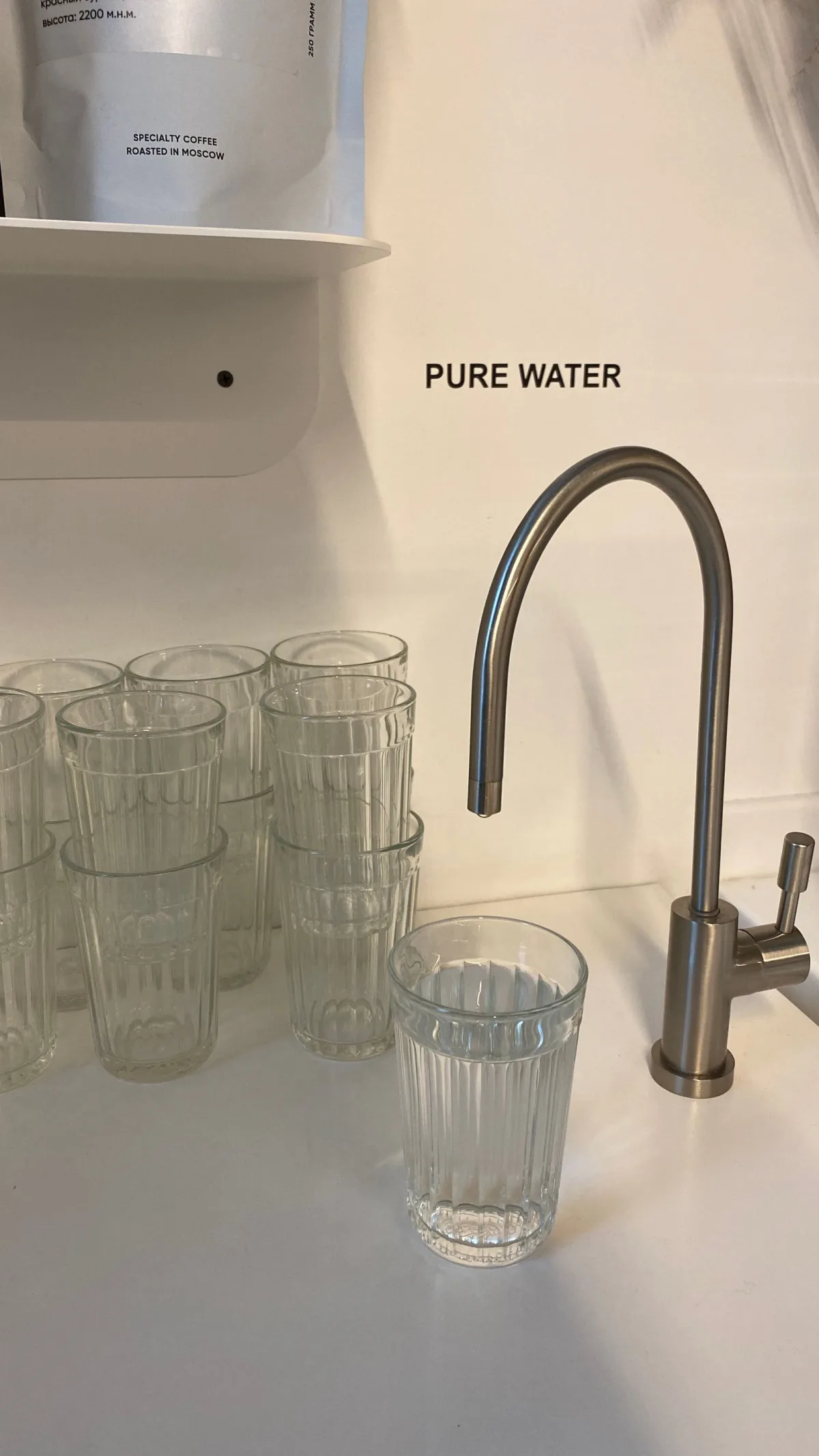
If you are pregnant or trying to conceive and weighing a water filter, reverse osmosis is the more complete choice because it reduces arsenic, lead, PFAS, and nitrate by roughly 90-99%, while carbon filters do not remove arsenic at all. Carbon block filters certified to NSF/ANSI 53 handle lead, PFAS, and chlorine, but arsenic does not bind to carbon, so it passes straight through. That gap is decisive in pregnancy: the health-protective arsenic guideline is 0.004 ppb, 2,500 times below the 10 ppb legal limit (OEHHA, 2004), and both lead and PFOA have no level considered safe for a developing baby.
The developing fetus is unusually exposed to what a mother drinks. Arsenic, lead, and PFAS all cross the placenta, and the fetal liver and blood-brain barrier are not finished forming, so a concentration an adult can clear is not one a fetus can. Picking the right filter is really one question: does it remove the specific contaminants that reach the placenta? Below is what each technology actually does, and why the answer is not the same for every contaminant.
Legal Limits vs. Safe Levels for Pregnancy
Legal limits are not health limits. The EPA sets Maximum Contaminant Levels by balancing health risk against what utilities can feasibly and affordably achieve, so the enforceable number can sit far above the level a fetus is protected at. The table below pairs each legal limit with the health-based target and the CheckYourTap safe level calibrated for pregnancy.
| Contaminant | EPA Legal Limit | Health-Based Goal | CheckYourTap Safe Level (Pregnancy) |
|---|---|---|---|
| Arsenic | 10 ppb | 0.004 ppb (OEHHA PHG) | 0.004 ppb (OEHHA, 2004) |
| PFOA | 4 ppt (MCL) | Zero (EPA MCLG) | No safe level - target 0 |
| Lead | 15 ppb action level (→10 ppb) | No safe level | No safe level - target 0 |
| Nitrate | 10 mg/L as N (MCL) | 10 mg/L as N (EPA MCLG) | Below 10 mg/L as N - guards against fetal/infant methemoglobinemia |
Two rows tell the story. Arsenic's legal limit is 2,500 times its health guideline, a gap the EPA itself acknowledged when it set the 10 ppb standard on feasibility grounds rather than safety. And for both PFOA and lead, there is no honest "safe" number to publish. The EPA's purely health-based goal (the MCLG) for PFOA is zero, and health agencies recognize no threshold below which lead is safe for fetal exposure. The 4 ppt figure for PFOA is the enforceable limit, not a promise of safety.
Note: ppb = parts per billion; ppt = parts per trillion; mg/L as N = milligrams per liter measured as nitrogen.
Which Filter Removes What? The Full Comparison
Here is the core comparison. No single home technology removes every contaminant equally, which is exactly why "just get a filter" is incomplete advice for pregnancy. Reverse osmosis is the only common option that covers all four contaminants that matter most here. Removal ranges below are defensible expectations for a well-maintained, certified system, not guarantees; real performance depends on certification, water chemistry, and upkeep.
| Filter Type | Certification | PFAS (incl. PFOA) | Arsenic | Lead | Nitrate |
|---|---|---|---|---|---|
| Reverse osmosis | NSF/ANSI 58 | High (~90-99%) | High (~90-99%) | High (~90-99%) | High (~90-99%) |
| Carbon block (under-sink) | NSF/ANSI 53 & 401 | Good if certified | Poor - does not bind | Good if 53-certified | Poor |
| Pitcher / fridge carbon | Varies (some 53/401) | Inconsistent | No | Only if certified | No |
| Ion exchange | NSF/ANSI 44 (cation softening) / 53 or 62 (arsenic) | Some anion resins | Good if built for arsenic | Some (cation) | Good (anion) |
A few things stand out. Carbon is genuinely good at what it is designed for: activated carbon block filters certified to NSF/ANSI 53 reduce lead, and carbon certified to NSF/ANSI 53 or 401 can reduce PFAS. But carbon has a blind spot for arsenic. Reverse osmosis, certified to NSF/ANSI 58, is the one option that closes the whole gap. Ion exchange can match RO contaminant-by-contaminant, but only if the resin is chosen for the specific target, which makes it more of a specialist tool than a default.
Why Doesn't Carbon Remove Arsenic?
Carbon fails on arsenic for a chemical reason, not a quality one. Activated carbon works by adsorption: contaminants stick to the vast porous surface of the carbon block. That mechanism is excellent for chlorine, many volatile organic compounds, PFAS, and, in certified blocks, lead. But dissolved arsenic exists mostly as charged ions (arsenate and arsenite) that do not adsorb onto carbon, so they flow through the filter untouched.
This is the trap with pitcher and refrigerator filters during pregnancy. They improve taste and can reduce some contaminants, but a family assuming their pitcher "handles" arsenic is unprotected against a metal that crosses the placenta at concentrations mirroring maternal blood. Inorganic arsenic exposure above the health guideline is associated with restricted fetal growth, low birth weight, and higher risk of preterm birth (Rahman et al., 2009). If a private well or a public system shows arsenic, carbon alone is not the answer. Reverse osmosis or a purpose-built arsenic system is.
What Makes Reverse Osmosis the More Complete Choice?
Reverse osmosis reduces roughly 90-99% of dissolved contaminants because it works by physical exclusion, not chemistry. Pressurized water is forced through a semi-permeable membrane whose pores are far too small for dissolved metals, PFAS molecules, and nitrate ions to pass. That single mechanism is why RO covers arsenic, lead, PFAS, and nitrate at once, where carbon covers only some of them.
For a pregnancy-focused household, that breadth is the point. RO is the most reliable home method for driving arsenic toward the 0.004 ppb health guideline while simultaneously reducing PFOA, whose EPA health goal is zero, and lead, which has no safe level in fetal exposure. Both metals and PFAS cross the placenta, and lead is compounded by pregnancy itself: bone remodeling releases lead stored over a lifetime back into the bloodstream (Bellinger, 2005).
One trade-off deserves a plan. Because RO strips dissolved solids indiscriminately, it also removes beneficial calcium and magnesium. Add a remineralization stage after the membrane, or keep mineral intake up through diet and prenatal vitamins, so the water that protects the baby does not shortchange maternal bone health.
Certification and Maintenance Actually Matter
A filter's rating means nothing if the system is not certified or not maintained. Look for the specific NSF/ANSI standard for your target: Standard 58 for reverse osmosis, Standard 53 for lead and other health contaminants in carbon, and Standard 401 for emerging compounds. A certification confirms the unit was independently tested to reduce that contaminant, rather than marketed with a vague "filters up to 99%" claim.
Maintenance is not optional either. Replace RO membranes every 2 to 3 years and carbon pre-filters every 6 to 12 months. A membrane left in place for five years may no longer reduce PFAS or arsenic the way it did when new. During pregnancy, a lapsed filter is a silent failure: the water looks and tastes the same while protection quietly degrades.
Why We Set a Pregnancy-Specific Number
CheckYourTap compares available records with authority-published health references and clearly labeled derived population estimates. Those comparisons do not establish a safe level, exposure, or health risk for a person or property; confirm the source and use a certified property sample.
The Practical Recommendation
If you want one filter to cover the contaminants that matter most in pregnancy, choose an under-sink reverse osmosis system certified to NSF/ANSI 58, and add a remineralization stage. If your water is confirmed free of arsenic and nitrate and your only concern is lead or PFAS, a carbon block certified to NSF/ANSI 53 and 401 is a reasonable, less expensive option. What you should not rely on is a standard pitcher or refrigerator filter as your sole protection, because coverage is inconsistent and arsenic is not addressed at all.
The starting point is not the filter aisle. It is knowing what is actually in your water, so you match the technology to the contaminant instead of guessing. Test a private well annually, and read your public system's data, before you spend a dollar on treatment.
This article is for general information and is not medical advice. Talk to your prenatal provider about your specific water source and any health concerns during pregnancy.
Keep Reading
- Is Tap Water Safe During Pregnancy? The Gap Between Legal and Safe
- Reverse Osmosis: What It Actually Removes From Your Water
- Arsenic in Well Water While Pregnant: What "Safe" Really Means
- Lead in Drinking Water During Pregnancy: Why There's No Safe Level
- PFAS, IVF, and Fertility: The Tap Water Connection
- Arsenic: sources, health effects, and safe levels
- Lead: sources, health effects, and safe levels
- PFOA: The Forever Chemical in Your Tap Water
Sources: California OEHHA Public Health Goals (arsenic, 0.004 ppb, 2004); EPA PFAS (PFOA MCL 4 ppt, MCLG zero, 2024); EPA National Primary Drinking Water Regulations (arsenic 10 ppb legal limit); EPA Lead and Copper Rule and Lead and Copper Rule Improvements (lead action level 15 ppb, lowering to 10 ppb); EWG Tap Water Database (health guidelines); Rahman et al., Epidemiology, 2009 (arsenic and pregnancy outcomes); Bellinger, Birth Defects Research, 2005 (lead and pregnancy). NSF/ANSI Standards 58, 53, and 401 govern filter certification for reverse osmosis, health-contaminant reduction, and emerging compounds respectively.
