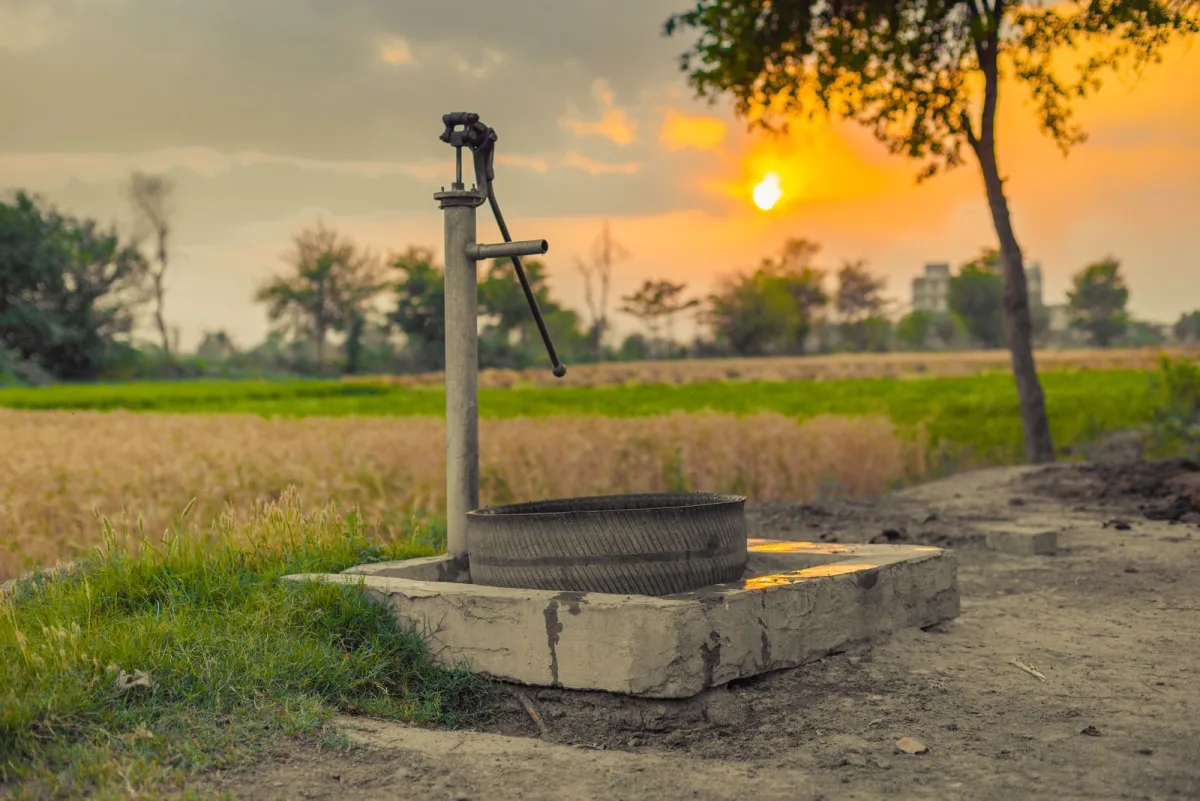
If you are pregnant and drink from a private well, the safe level of arsenic is far below what the law allows. The EPA's legal limit is 10 parts per billion (ppb), but the health-protective guideline for a developing baby is 0.004 ppb, the California OEHHA public health goal. That is a 2,500x gap. Arsenic crosses the placenta, the fetal liver cannot fully detoxify it, and exposure well under the legal limit is tied to low birth weight and preterm birth.
Here's what makes wells different. Private wells aren't covered by the federal Safe Drinking Water Act, so no agency tests or treats your water before it reaches your tap. A city customer at least gets an annual compliance report. A well owner gets nothing unless they order the test themselves. Groundwater also changes over time, and arsenic occurs naturally in bedrock across much of the country, so a clean result from years ago doesn't mean the water is clean now.
This post covers the real safe number, why the legal limit misses it, and what actually removes arsenic during pregnancy. It's national guidance, not tied to any one state.
Legal Limit vs. Health Guideline for Arsenic
The table below compares three numbers: the EPA legal limit, the Environmental Working Group (EWG) health guideline, and the health-protective anchor we use for pregnancy. To be clear, that anchor is the same 0.004 ppb figure EWG cites, the California OEHHA public health goal. We don't invent a separate published pregnancy threshold. We adopt the strictest existing health-based number and, as noted below, treat any pregnancy-specific adjustment as a directional refinement, not a new hard limit.
| Contaminant | EPA Legal Limit (MCL) | EWG Health Guideline | Health-Protective Anchor (Pregnancy) |
|---|---|---|---|
| Arsenic | 10 ppb | 0.004 ppb | 0.004 ppb (OEHHA, 2004) |
One row of a table, and an uncomfortable fact inside it. The legal limit sits 2,500 times above the level tied to a genuinely negligible risk. That kind of gap shows up with a lot of contaminants. It matters more here, because arsenic crosses the placenta and builds up in fetal tissue.
Citation capsule: The EPA's legal limit for arsenic in drinking water is 10 ppb, while the California OEHHA public health goal, the level tied to negligible lifetime cancer risk, is 0.004 ppb (OEHHA, 2004). The legal limit is therefore 2,500 times higher than the health-protective guideline.
Why Isn't the Legal Arsenic Limit a Health Limit?
The EPA set the arsenic limit at 10 ppb in 2001, tightening it from the old 50 ppb standard. Even so, the National Research Council estimated that lifetime exposure at 10 ppb carries a combined lung and bladder cancer risk near 1 in 300 (National Research Council, 2001). That is far above the 1-in-10,000 ceiling of the EPA's own acceptable-risk range for drinking water carcinogens. The 10 ppb limit was a feasibility standard, a balance of treatment cost against risk, not a line where arsenic becomes safe.
The health science drew the line somewhere else entirely. The California Office of Environmental Health Hazard Assessment (OEHHA) set a public health goal of 0.004 ppb, the concentration tied to negligible added risk over a lifetime. That's the number our pregnancy safe level anchors to. So a well can be "in compliance" and still carry thousands of times the arsenic a fetus is protected against. Legal and safe are not the same word.
Our own vulnerability model adjusts the adult OEHHA goal for how much water people drink during pregnancy, and it lands lower still, around 0.0033 ppb. We publish the 0.004 ppb anchor as the headline number anyway, and treat our adjusted figure as a supporting estimate rather than a hard threshold. Sourced beats precise-sounding.
How Does Arsenic Harm a Developing Fetus?
Inorganic arsenic passes through the placenta easily, so the fetus sees concentrations that mirror the mother's blood (Concha et al., 1998). The placenta blocks many toxins. It does not block this one. And the fetal liver hasn't finished building the enzymes that break arsenic down and clear it out, so a baby hangs onto more of it, for longer, than the mother does.
That unfinished liver is the whole problem. The half-processed forms of arsenic that pile up, including one called MMA-III, damage cells and interfere with how genes get switched on and off, right when cells are dividing fastest (ATSDR Toxicological Profile for Arsenic, 2007). Population studies link maternal arsenic exposure to lower birth weight and more preterm births (Rahman et al., 2009). Later work ties early-life exposure to measurable deficits in children's cognitive function (Wasserman et al., 2004).
There's a timing trap here too. Arsenic clears the body in a matter of days, which sounds reassuring until you realize what daily well water does. Each glass tops the level back up, so the fetus is exposed more or less continuously (ATSDR Toxicological Profile for Arsenic, 2007). It never fully washes out. That's why "our arsenic is only a little over the limit" is the wrong way to think during pregnancy.
Citation capsule: Inorganic arsenic crosses the placenta at concentrations mirroring maternal blood, and the immature fetal liver cannot fully methylate and excrete it (Concha et al., 1998). Prenatal exposure is associated with reduced birth weight and increased preterm birth risk (Rahman et al., 2009).
How Common Is Arsenic in Private Wells?
Arsenic in wells is not a rare, regional oddity. A U.S. Geological Survey analysis estimated that about 2.1 million people relying on private wells drink water with arsenic above the 10 ppb legal limit, with many millions more sitting somewhere between 0.004 ppb and 10 ppb (USGS, 2017). Those in-between wells are the quiet danger: legal, undetected, and still far above the pregnancy safe level.
The wells that pass are riskier than the wells that fail. A well testing at 9 ppb clears the legal bar, so nobody flags it, yet it carries more than 2,000 times the pregnancy health guideline. A well at 40 ppb usually gets caught and treated. The regulatory framing trains people to worry about the obvious failures and ignore the "passing" wells that quietly exceed every health-based number. During pregnancy, that blind spot is the one that matters.
Because arsenic is odorless, tasteless, and invisible, testing is the only way to know. Groundwater chemistry shifts with drought, new pumping, and seasonal recharge, so a single clean result years ago says little about today.
What Actually Removes Arsenic From Well Water?
Filter choice decides everything here, and most common filters do nothing for arsenic. Carbon pitchers and fridge filters, the Brita-and-PUR tier, are not built to reduce inorganic arsenic. Reaching the 0.004 ppb pregnancy guideline takes one of three technologies matched to your water.
Reverse osmosis (the reliable default)
Reverse osmosis (RO) forces water through a semi-permeable membrane and removes up to 99% of inorganic arsenic, both arsenic III and arsenic V, along with lead, nitrate, and PFAS. EPA recognizes reverse osmosis as a best available technology for arsenic removal (EPA Arsenic Rule), and a unit certified to NSF/ANSI Standard 58 for arsenic reduction verifies that removal claim for the specific system. For pregnancy, an under-sink RO unit with that certification is the gold standard. RO also strips beneficial minerals, so keep calcium and magnesium up through diet or prenatal vitamins.
Ion exchange and activated alumina (well-specific options)
Whole-house anion exchange resins can remove arsenic but need regular regeneration and maintenance. Activated alumina targets arsenic specifically and works well as a point-of-entry option for high-arsenic wells. One catch: much well arsenic exists as arsenic III, which is hard to filter, so some systems add an oxidation step to convert it to the easier-to-remove arsenic V before filtration.
A warning that catches people off guard: do not boil well water to make it safer to drink during pregnancy. Boiling kills microbes, but it evaporates water and concentrates arsenic and other heavy metals rather than removing them. You end up with more arsenic per glass, not less.
Why we set a pregnancy-specific number
CheckYourTap compares available records with authority-published health references and clearly labeled derived population estimates. Those comparisons do not establish a safe level, exposure, or health risk for a person or property; confirm the source and use a certified property sample.
The Bottom Line for Well Owners
Once a pregnancy is involved, leaning on the EPA's 10 ppb limit is a gamble. Arsenic crosses the placenta. The fetus can't clear it. Concentrations far below the legal limit are linked to low birth weight and preterm birth. The safe target is 0.004 ppb, 2,500 times stricter than the law. Test your well with a lab that measures down to that level. If arsenic shows up, install an NSF/ANSI 58 reverse-osmosis system for the water you drink and cook with. That one step closes the gap between "legal" and "safe for your baby."
This article is for general information and is not medical advice. Talk to your prenatal provider about your specific well, your test results, and any health concerns.
Keep Reading
- Is Tap Water Safe During Pregnancy? The Gap Between Legal and Safe
- Your Well Arsenic Test Said 'Safe.' Here's What That Really Means
- Arsenic: sources, health effects, and safe levels
Sources: California OEHHA Public Health Goals (arsenic, 0.004 ppb, 2004); EPA Arsenic Rule (arsenic MCL 10 ppb, 2001; reverse osmosis as best available technology); National Research Council, Arsenic in Drinking Water: 2001 Update (combined cancer risk near 1 in 300 at 10 ppb); ATSDR Toxicological Profile for Arsenic, 2007 (metabolism, MMA-III, biological half-life); EWG Tap Water Database (health guideline); USGS Arsenic and Drinking Water (private-well exposure); Concha et al., 1998, on placental arsenic transfer; Rahman et al., 2009, on arsenic and birth outcomes; Wasserman et al., 2004, on arsenic and children's cognition.
