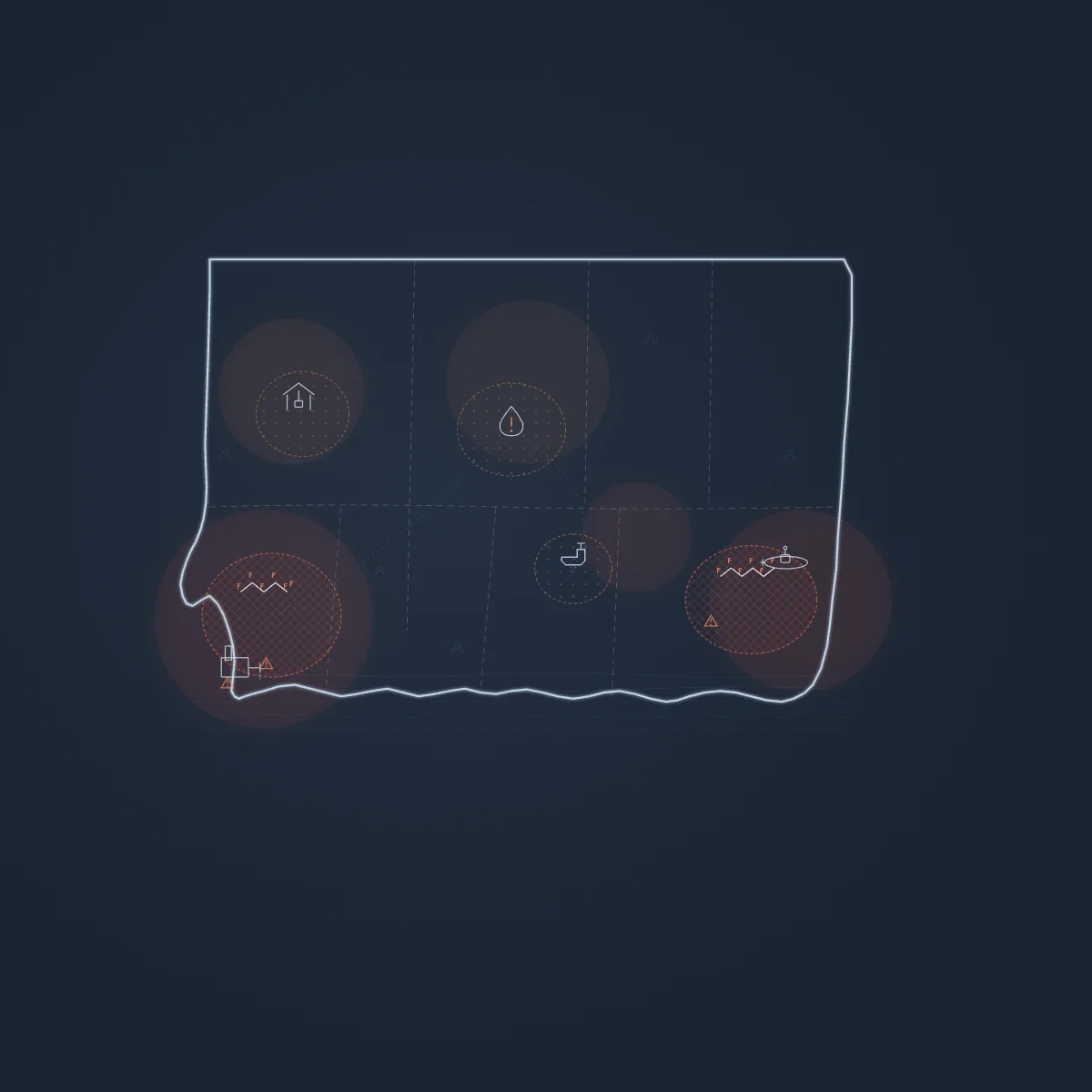
An estimated 176 million Americans are drinking water tainted with PFAS, according to the Environmental Working Group's 2026 analysis of EPA data. Connecticut ranks among the hardest-hit states. Thirty-nine public systems have tested positive. More than 2,400 sites are queued for investigation. And as of April 2026, a new surcharge on utility bills means you're paying for the cleanup whether you know it or not.
This guide covers everything CT residents need to know about forever chemicals in 2026: what they are, what they do to your body, where they've been found, what the legal limits mean, how to filter them out, and who's footing the bill.
- 39 public systems have detections; ~2,400 more sites await investigation (CT Mirror, 2025)
- PFOA is now classified as a Group 1 carcinogen by IARC
- CT's own action levels are less strict than EPA limits — "compliant" supply may exceed federal standards
- Reverse osmosis removes 94-99% of forever chemicals at home for $150-$1,000
- Private well owners (~300,000 residents) have no testing requirement and no utility treatment
What Are PFAS and Why Should Connecticut Residents Care?
The EPA's CompTox Dashboard lists roughly 15,000 PFAS compounds — a class of synthetic chemicals that don't break down in the environment or your body. The state has one of the highest densities of confirmed contamination sites in the Northeast, with military bases, industrial facilities, and fire stations all contributing to the problem.
PFAS stands for per- and polyfluoroalkyl substances. The chemistry is simple in concept: carbon-fluorine bonds are among the strongest in organic chemistry. That strength is exactly the problem. These molecules resist heat, oil, and biological degradation. They persist in soil, groundwater, and blood for years or decades.
The history starts in the 1940s. 3M acquired the electrochemical fluorination process in 1945. DuPont began manufacturing Teflon in 1951. By the 1960s, these compounds were in firefighting foam (AFFF), nonstick cookware, Scotchgard, food packaging, and waterproof clothing. The chemicals worked brilliantly for their intended purposes. Nobody studied what happened when they entered the supply.
Now we know. The CDC's biomonitoring program has found PFAS in the blood of 99% of Americans tested. The chemicals accumulate. They don't flush out. And the health consequences are serious.
What Does PFAS Do to Your Body?
The International Agency for Research on Cancer classified PFOA as a Group 1 carcinogen in November 2023 — the highest category, alongside asbestos and tobacco smoke. The evidence against forever chemicals is no longer preliminary. It is extensive, peer-reviewed, and growing.
Cancer
A 2023 meta-analysis in PMC found that high exposure was associated with a 74% increased risk of kidney cancer (RR=1.74) and a 122% increased risk of testicular cancer (RR=2.22). These aren't small effect sizes. A separate study in The Lancet eBioMedicine found a 56% increased rate of thyroid cancer per doubling of n-PFOS concentration in blood.
We've written more about the connection between forever chemicals, thyroid disruption, and hair loss — a link that's gaining traction in the research but getting almost no attention from primary care physicians.
Fertility and Reproductive Health
The National Institute of Environmental Health Sciences has documented that exposure can reduce fertility in women by up to 40%. The mechanism involves disruption of hormone signaling, ovarian function, and implantation. For couples struggling to conceive, what comes out of the tap could be a contributing factor nobody thinks to test for. If you're pregnant or planning to be, our guide on CT water quality during pregnancy covers specific risks by region.
Cholesterol and Cardiovascular Risk
A 2025 meta-analysis found 18-21% increased odds of hypercholesterolemia associated with exposure to these compounds. High cholesterol driven by forever chemicals isn't the same as diet-related cholesterol. Statins treat the symptom. They don't address the source.
Immune System
Research from Johns Hopkins (2025) documented reduced vaccine response in children with elevated exposure. A University of Rochester study published through NCATS in 2025 found that pre-birth exposure lowers T cell levels, potentially compromising immune function from day one. Your child's flu shot may be less effective because of what was in the tap during pregnancy.
Has your doctor ever asked about your supply when evaluating unexplained health symptoms? Probably not. The research says they should.
When we analyzed CheckYourTap data across Connecticut ZIP codes, the overlap between high-detection areas and communities with elevated health concerns was striking. The data doesn't prove causation on its own. But it raises questions that residents deserve answers to.
Where Has PFAS Been Found in Connecticut?
Thirty-nine public systems have tested positive, according to CT Department of Public Health data. Beyond those, the CT Mirror reports approximately 700 confirmed contaminated sites statewide, with more than 2,400 additional locations queued for investigation. The USGS estimates a greater than 75% probability of contamination in southwestern CT groundwater, meaning 67-87% of private well users in that region may be affected.
The contamination comes from four categories. Each one has left a distinct mark on the state's supply.
Military Installations
The worst single detection belongs to Bradley Air National Guard Base in Windsor Locks: 10,580 parts per trillion. That is 2,645 times the EPA's 4 ppt limit. In 2019, approximately 50,000 gallons of AFFF firefighting foam were accidentally released at Bradley, flowing into the Farmington River. Months later, a B-17 crash triggered another 25,000 gallons. Seventy-five thousand gallons of foam in one year.
The Naval Submarine Base in Groton is an EPA Superfund site. Decades of AFFF use have contaminated groundwater near the base, and the Navy has been testing private wells in the surrounding area since 2019.
Industrial Facilities
In New Milford, Kimberly-Clark operated a 165-acre unlined landfill from 1969 to 2010. That's four decades of industrial waste disposal with nothing between the chemicals and the aquifer. Private wells near the site have shown contamination.
Fire Departments
In Killingworth, the town's own fire department contaminated private wells through AFFF discharge during training exercises. The irony is brutal: the people trained to protect the community inadvertently poisoned its supply. This pattern repeats at fire stations across the state and the country.
Airports
Bradley International Airport's AFFF usage extends beyond the military base. Commercial airports routinely use fluorinated firefighting foam for emergency preparedness. The contamination plume doesn't respect property boundaries between the Air National Guard installation and the civilian terminal.
Connecticut's problem isn't a single spill or a single factory. It's a layered, decades-long accumulation from military, industrial, municipal, and commercial sources — all converging on the same aquifers. That makes remediation fundamentally harder than cleaning up one point source. You can't just shut off one tap.
What Are the Legal Limits for PFAS in Drinking Water?
In April 2024, the EPA set its first-ever enforceable limits for forever chemicals: 4 ppt for PFOA, 4 ppt for PFOS, and 10 ppt each for PFHxS, PFNA, and GenX. By May 2025, the agency announced it would retain PFOA and PFOS limits but intended to rescind limits for three other compounds while extending the compliance deadline to 2031.
The courts had other ideas. On January 21, 2026, the D.C. Circuit Court denied the EPA's motion to vacate the hazard index portion of the rule. On March 19, 2026, the same court denied a severance request. The legal battle continues, but for now, the original rule stands.
For a full breakdown of how the surcharge connects to these regulations, including the compound-by-compound table with all 10 CT-regulated substances, see our surcharge explainer.
Connecticut vs. Federal Standards
Here's the part that confuses people. The state's own action levels are less strict than the EPA's limits for the two most common compounds:
| Compound | CT Action Level (ppt) | EPA MCL (ppt) | Status | |----------|----------------------|---------------|--------| | PFOA | 16 | 4 | EPA retained | | PFOS | 10 | 4 | EPA retained | | PFNA | 12 | 10 | EPA rescission intended | | GenX | 19 | 10 | EPA rescission intended | | PFHxS | 49 | 10 | EPA rescission intended |
A utility can pass the state test and fail the federal one. Your provider might report "within state action levels" while simultaneously exceeding EPA limits by two to four times. The full compound table shows five additional substances that the state monitors but the feds don't regulate at all.
CT regulates 10 compounds. The federal government, depending on how the court battles resolve, may enforce limits on as few as two. If the EPA succeeds in rescinding limits for PFNA, GenX, and PFHxS, the state's action levels become the only regulatory floor for those chemicals. Whether those levels are protective enough is debatable. But they exist, which puts Connecticut ahead of most states.
How Can You Remove PFAS from Your Drinking Water?
A Duke University study tested home filters and found that reverse osmosis systems removed 94% or more of forever chemicals, while results for other filter types varied dramatically. Not all filters are equal. Some are nearly useless. The technology you choose matters more than whether you filter at all. Our reverse osmosis guide for CT covers installation, maintenance, and cost in detail.
Here's how the major filter technologies compare:
| Technology | Removal Rate | Typical Cost | NSF Standard | Best For | |-----------|-------------|-------------|-------------|----------| | Reverse Osmosis | 94-99% | $150-$1,000 | NSF/ANSI 58 | Most effective; catches short-chain compounds too | | Granular Activated Carbon | 0-73% (varies widely) | $20-$1,000 | NSF/ANSI 53 | Better for long-chain compounds (PFOA/PFOS) | | Ion Exchange Resin | High (emerging data) | $20-$1,000 | NSF/ANSI 53 | Targeted contaminant removal | | Pitcher Filter (Brita) | Limited to ineffective | $20-$40 | NSF 42 only | NOT recommended for PFAS |
Source: Duke University, EPA, Consumer Reports
Why RO Wins
Reverse osmosis forces water through a semi-permeable membrane with pores small enough to block these molecules. It catches both long-chain compounds like PFOA and PFOS and the shorter-chain varieties that slip through activated carbon. A point-of-use system under your kitchen sink costs $150 to $400. Whole-house systems run $1,000 to $4,000.
The Activated Carbon Problem
Granular activated carbon (GAC) can reduce contamination, but the performance range is enormous — from near-zero to 73%. Effectiveness depends on the specific compound, the carbon type, contact time, and how saturated the filter is. A brand-new GAC filter performs very differently from one that's six months old. For forever chemicals specifically, GAC is unreliable unless the filter is certified to NSF/ANSI 53 for PFAS reduction.
What Doesn't Work
Boiling doesn't remove forever chemicals. These compounds are thermally stable to temperatures far beyond what your stove produces. Boiling actually concentrates them by reducing volume. Standard pitcher filters certified only to NSF 42 (taste and odor) don't meaningfully reduce contamination either.
We've found that people often assume any filter is better than nothing when it comes to these contaminants. That's not true. A Brita pitcher gives you a false sense of security. If forever chemicals are your concern, skip the pitcher and go straight to reverse osmosis. The price difference between a $30 pitcher and a $200 RO system is small compared to years of thinking you're protected when you're not.
How Can You Get Your Water Tested for PFAS?
If you're on public supply, your utility is required by law to publish an annual Consumer Confidence Report (CCR) by July 1 each year, and EPA's UCMR 5 program now requires testing for all large systems serving more than 3,300 people. Check your utility's website or call them directly. The data should include results from the 2023-2025 testing cycle.
Private Well Testing
If you're on a private well, nobody is checking your supply unless you do it yourself. The state has no ongoing testing requirement for existing wells. Your options:
CT DEEP certified labs. A full panel costs $300 to $400. The CT DEEP website lists certified labs. At minimum, test for PFOA and PFOS. Ideally, request the full 10-compound panel that matches CT DPH action levels.
UConn CTIWR program. The Connecticut Institute of Water Resources has offered subsidized testing for $100 to $200. Check current availability — grant funding runs out and slots fill quickly.
How Often Should You Test?
If you're within a few miles of a known contamination source (military base, industrial site, fire station that used AFFF), test annually. If you're in southwestern CT where USGS estimates high contamination probability, test every one to two years. Everyone else on private wells should test every three to five years.
What should you test for? At minimum, PFOA and PFOS. But contamination rarely involves just two compounds. The full CT DPH panel of 10 substances gives you a much clearer picture — and it's the only way to know if you're exceeding state action levels for less-common compounds like 6:2 Cl-PFESA (action level: 2 ppt) or 8:2 Cl-PFESA (action level: 5 ppt).
The standard mortgage test your bank required when you bought the house doesn't include PFAS. Most homeowners don't realize this until they test specifically.
About 300,000 Connecticut residents rely on private wells with no utility treatment and no regulatory testing requirement, even though the USGS estimates greater than 75% contamination probability in southwestern CT groundwater.
Who Is Paying for PFAS Cleanup in Connecticut?
Connecticut Water's treatment costs total $241.7 million across 35 sources, according to Hartford Business Journal. The company has received just $7.6 million in settlement money so far — roughly 3% of costs. The rest comes from ratepayers.
For the full surcharge breakdown and cost analysis, see our detailed explainer.
The Lawsuits
The money trail tells the story of who created this problem and who's paying to fix it.
3M settlement. $10.5 to $12.5 billion over 13 years to public suppliers nationally. About $3 billion has been distributed so far.
DuPont, Chemours, and Corteva. $1.185 billion combined.
Connecticut AG lawsuit. Attorney General William Tong sued 28 chemical manufacturers in January 2024 for contamination and harm to public health.
The Gap
Connecticut Water's $7.6 million against $190 million or more in costs. That's a 3% recovery rate. Aquarion, serving Fairfield County, has committed roughly $150 million to its own treatment program. Settlement money will trickle in over years. The treatment is needed now.
The Surcharge
The Water Quality and Treatment Adjustment (WQTA) adds 0.53% to every Connecticut Water bill starting April 2026. On a typical $44 monthly bill, that's about $0.23 per month. Small today. Designed to increase.
Federal Funding
The Bipartisan Infrastructure Law allocated $10 billion specifically for treatment and $15 billion for lead pipe replacement. How much reaches CT depends on the state's applications and the federal administration's priorities.
Private Well Owners
About 300,000 residents rely on private wells. They don't pay the surcharge. They also get zero treatment, zero testing, and zero reimbursement. If your well tests positive, the filter is on you.
What Can You Do About PFAS Right Now?
You don't have to wait for utilities to reach compliance in 2031. You don't have to wait for lawsuits to resolve. There are steps you can take this week.
Step 1: Find out what's in your supply. If you're on public service, pull up your utility's Consumer Confidence Report. If the numbers aren't there yet, call and ask when UCMR 5 results will be published. If you're on a private well, get tested.
Find out what's in your water. Enter your ZIP code at CheckYourTap.com to see your tap water report — free, in 30 seconds.
Step 2: Install a reverse osmosis system. A point-of-use RO unit under your kitchen sink costs $150 to $400 and removes 94-99% of these contaminants. That's the water you drink and cook with. Compare that one-time cost to years of exposure while waiting for utility-scale treatment to come online.
Step 3: If you're on a private well, test now. The standard test your bank required when you bought the house doesn't cover these compounds. You need a specific panel from a CT DEEP certified lab ($300-$400) or through the UConn CTIWR program if subsidized testing is available.
Step 4: Understand what you're paying for. The WQTA surcharge means your bill is funding cleanup. That's real treatment for real contamination. But compliance deadlines stretch to 2031. The surcharge doesn't mean your tap is clean today.
Step 5: Talk to your doctor. If you've been on contaminated supply and have unexplained thyroid symptoms, elevated cholesterol, or fertility concerns, ask about serum testing. The connection between these chemicals, thyroid disruption, and downstream health effects is well-documented in the research. Most doctors won't think to ask about your supply. You have to bring it up.
The math is simple. A $200 reverse osmosis system protects your family starting today. The utility-scale cleanup will take years and cost billions. Both matter. But one of them is within your control right now.
Keep Reading
- Your Connecticut Water Bill Is Going Up Because of PFAS. Here's What You're Actually Paying For.
- Fairfield County Has a PFAS Problem and Your Water Bill Won't Fix It Until 2031
- The Navy Has Been Poisoning the Water in Groton for Decades.
- The Connection Between Your Water, Your Thyroid, and Your Hair That Nobody Is Making
Sources: EPA PFAS Health Risks; EPA PFAS NPDWR; EPA Retains PFOA/PFOS MCLs; EPA CompTox PFAS List; EPA Filter Certification; EPA Infrastructure Fact Sheet; IARC PFOA/PFOS Classification; PMC Cancer Meta-Analysis; Lancet Thyroid Cancer; NIEHS Fertility; NCATS Immune System; Duke University Filter Study; CT DPH PFAS; CT DEEP Private Wells; CT AG Lawsuit; USGS/CT News Junkie; CT Mirror; Hartford Business Journal, Surcharge; Hartford Business Journal, Settlement; EWG 176M Exposed; ASDWA Court Ruling; 3M Settlement; DuPont Settlement; UConn Well Testing; Consumer Reports Filters; CT Public, Well Water.