If you live in Fairfield County, you've probably noticed that thyroid disease is common. It comes up at dinner parties, in pediatricians' offices, in conversations between women in their thirties and forties trying to figure out why they're exhausted, why they're gaining weight, why their hair is thinning.
The standard explanation is that thyroid disease is common everywhere. It affects an estimated 20 million Americans, and Fairfield County's high rates of diagnosis reflect better access to healthcare and more frequent testing, not necessarily higher actual prevalence.
That explanation may be partially right. It's probably not the complete story.
How Does PFAS Affect the Thyroid?
PFAS compounds are endocrine disruptors. This is not a contested claim; it's established in the peer-reviewed literature. The mechanism is fairly well understood. PFAS compounds, particularly PFOA and PFOS, interfere with the proteins that carry thyroid hormone in the blood, which reduces how much hormone is actually available. They also appear to affect the thyroid gland's ability to produce hormone in the first place.
The clearest single data point comes from a 2010 study in Environmental Health Perspectives that analyzed national NHANES biomonitoring data. Women in the top quarter of serum PFOA had roughly double the odds of treated thyroid disease compared with the lowest quartiles (odds ratio 2.2, 95% confidence interval 1.4-3.7). That's an association in a cross-section of the population, not proof that the PFOA caused the disease. But it's a real, statistically significant signal, and it's specific to the most-exposed group.
More recent work fills in the size of the effect. A 2025 study of a PFAS-exposed Michigan community (728 residents with a history of contaminated drinking water) found that a higher PFAS mixture was associated with only about a 2% decrease in total T3. That's a small shift, below the level that causes symptoms, not overt thyroid failure. The distinction matters for how much weight the hair-loss link can bear, and I'll come back to it below.
Can Thyroid Problems from PFAS Cause Hair Loss?
Thyroid dysfunction, particularly hypothyroidism, where the thyroid produces too little hormone, is one of the most common causes of diffuse hair loss in adults, as the American Thyroid Association has documented. The mechanism is direct. Thyroid hormones regulate the hair growth cycle. When levels run low, hair follicles spend more time in the resting (telogen) phase and less time in the growth (anagen) phase. The result is diffuse thinning across the scalp.
This is not subtle hair loss. It's the kind that prompts people to see a dermatologist, who orders a thyroid panel, finds hypothyroidism, and prescribes levothyroxine. The hair loss improves. The patient is grateful. Nobody asks what caused the thyroid dysfunction.
How much worse is the hair loss? A 2024 study of 500 patients with telogen effluvium put a number on it. Those with overt hypothyroidism had substantially more severe shedding than those with normal thyroid function (a mean severity score of 44.2 versus 25.6). The catch, and it's an important one, is that this was measured in people with diagnosed, overt hypothyroidism, not people with the small hormone shifts seen at typical PFAS exposure.
What This Chain Does and Doesn't Prove
It's worth being clear about the strength of each link, because the honest version is more useful than the scary one. Three things are separately well-supported. PFAS is associated with thyroid disease in the most-exposed people (the 2010 NHANES odds ratio of 2.2). Overt hypothyroidism clearly worsens hair loss (the 2024 severity data). And Fairfield County has documented PFAS in parts of its supply.
What is not established is that everyday PFAS exposure moves a typical person all the way from "normal thyroid" to the "overt hypothyroidism" that Dayel's patients had. The measured effect of a PFAS mixture on thyroid hormone, that roughly 2% drop in T3, is small and below the symptom threshold. So the accurate framing is a plausible chain with a real gap in the middle, not a proven cause. If you're already predisposed to thyroid problems, or you're in a vulnerable group like pregnancy, that gap is worth taking seriously. If you're not, it's a reason to test your water and watch your thyroid, not to panic.
The Fairfield County Situation
Aquarion Water Company, which serves most of Fairfield County, has a documented PFAS problem in its groundwater-dependent supply sources. The company has committed to a roughly $150 million remediation program. The compliance deadline is 2029; 2031 is only a proposed, requestable extension.
Until that treatment is built, Fairfield County residents on Aquarion's system are drinking water that may contain PFAS above the EPA's new limits. PFAS accumulates in the body; it doesn't clear quickly. Long-term, low-level exposure is the relevant scenario for most Fairfield County residents.
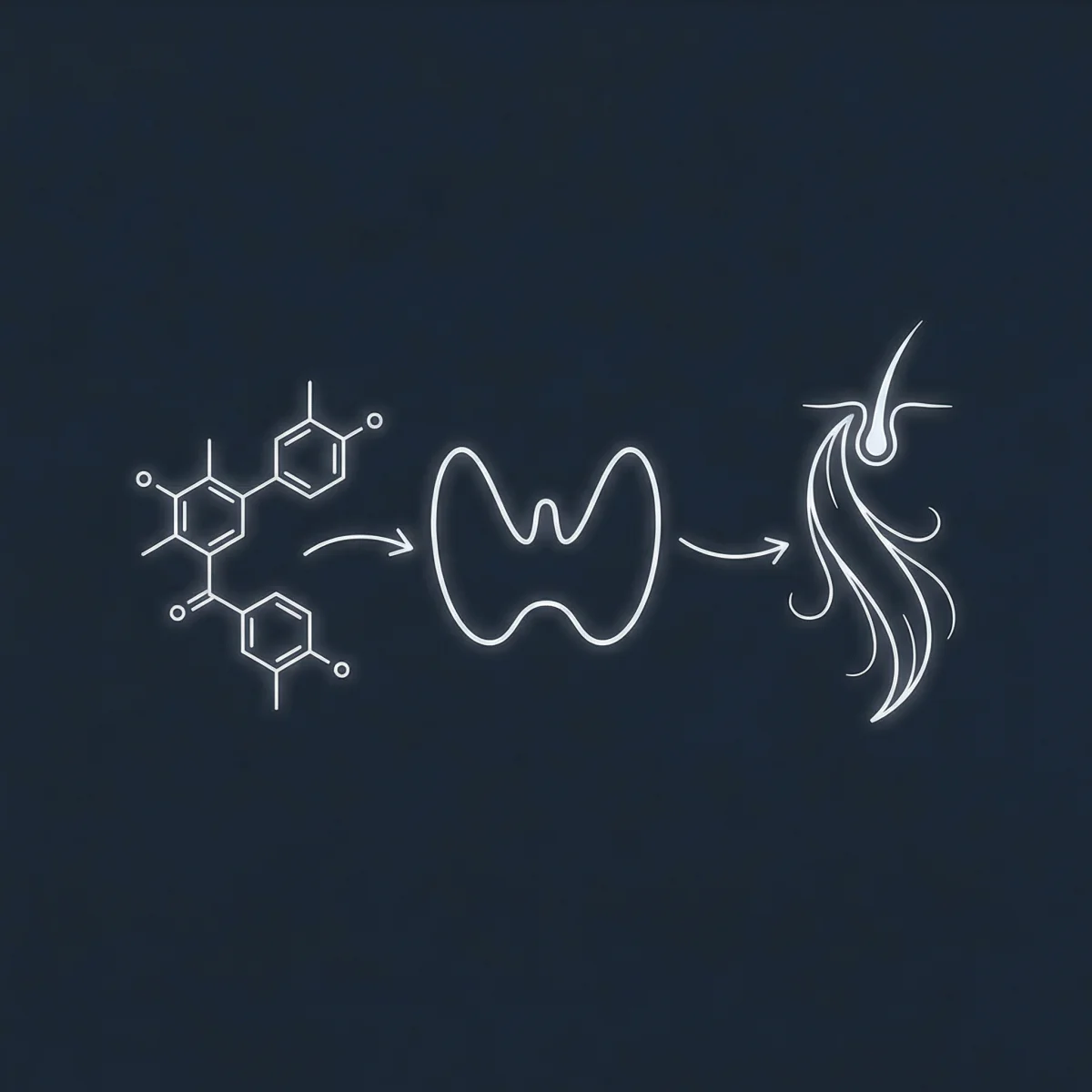
The chain runs from PFAS in Fairfield County water, to accumulation in residents, to thyroid disruption, to hair loss and other thyroid symptoms. It has peer-reviewed support at each individual link, even if, as noted above, the middle of the chain is an association rather than a proven cause. What's striking is that the chain as a whole is rarely discussed, so most people never think to connect their water to their thyroid at all.
Reading this inside ChatGPT or Claude?
This page can explain the general science about your tap water, but it cannot identify what is at a specific tap or property. You can get ZIP-level context two ways:
- Inside the chat: ask your assistant to “check my tap water with CheckYourTap”. Our connector returns available public-system or regional monitoring records associated with your ZIP. It does not identify your serving utility or test your tap, well, or property. The current connector is read-only and does not email reports or submit contact information.
- On the web: open CheckYourTap.com and enter your ZIP code for a free ZIP-level report.
What This Means Practically
Want ZIP-level context before deciding whether to test? Enter your ZIP code at CheckYourTap.com to see available public-system or regional monitoring records associated with the ZIP. This is not a test of a tap, well, or property. Free, in 30 seconds.
This is not a claim that PFAS in Fairfield County water is causing a thyroid epidemic. It's a claim that if you live in Fairfield County, are on Aquarion's water system, and are experiencing unexplained hair loss, fatigue, weight gain, or other thyroid symptoms, the water is a plausible contributing factor that your doctor is almost certainly not considering.
The conversation to have with your doctor is: "I'm on Aquarion's water system in Fairfield County. I know there's documented PFAS in the supply. Is it worth testing my thyroid antibodies and my serum PFAS levels?"
The answer, given the research, is yes.
The practical step is a reverse osmosis filter at your kitchen tap. RO removes PFAS effectively. It doesn't undo past exposure, but it stops the ongoing accumulation. And if you're a Connecticut Water or Aquarion customer, your water bill is already going up to pay for PFAS treatment, though the surcharge doesn't mean your water is fully treated yet.
Keep Reading
- Fairfield County PFAS: Legal Is Not the Same as Safe
- Your Connecticut Water Bill Is Going Up Because of PFAS. Here's What You're Actually Paying For.
- You're Pregnant in Connecticut. Here's What to Know About Your Water Before Your Next Glass.
Sources: Melzer et al., "Association Between Serum Perfluorooctanoic Acid (PFOA) and Thyroid Disease in the U.S. NHANES," Environmental Health Perspectives, 2010 (PMID 20089479); Noyes et al., "Per- and polyfluoroalkyl substances affect thyroid hormones," Scientific Reports, 2025; Bin Dayel et al., "Is thyroid dysfunction a common cause of telogen effluvium?" Medicine (Baltimore), 2024 (PMID 38181279); American Thyroid Association, hypothyroidism and hair loss; Hartford Business Journal, Aquarion PFAS, March 2026. Odds ratios and severity scores are associations from observational studies, not proof of causation.
