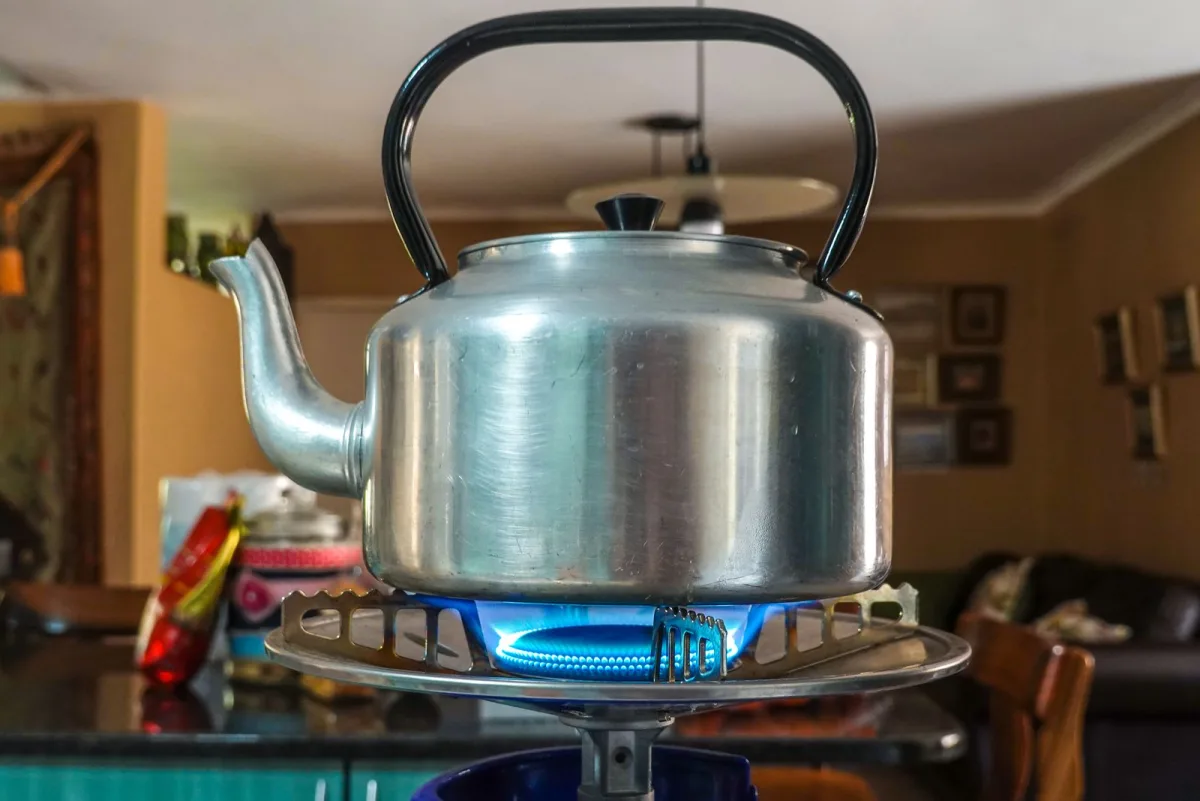
Boiling tap water for baby formula kills bacteria, but it will not remove the lead or arsenic that water may carry. Those metals do not boil off. As water turns to steam, they stay behind in a shrinking volume, so a pot boiled down leaves more metal per bottle, not less. A brief one-minute rolling boil evaporates only about 1 to 2% of the water, a negligible bump, but prolonged boiling or reducing concentrates it meaningfully. Health science recognizes no safe level of lead for a newborn, and the strict arsenic guideline is 0.004 ppb, 2,500 times below the 10 ppb legal limit. The right sequence is simple: filter the water first, then boil the filtered water if your pediatrician recommends it for germs.
Here is the knot this post untangles. For formula, boiling is not bad advice. Powdered infant formula is not sterile, and health guidance genuinely recommends preparing it with water that has been boiled and cooled to kill pathogens. So "never boil" would be wrong. The real point is narrower: boiling solves the germ problem and does nothing for the metal problem. Treat them as two separate jobs.
This is national guidance for formula-fed newborns, not tied to any one state.
Legal Limits vs. Newborn-Safe Levels for Lead and Arsenic
Federal tap-water limits were set around average adult body weights and what utilities can feasibly afford, not a 4-kilogram newborn who takes in roughly 150 milliliters of water per kilogram of body weight each day. The table compares the EPA legal figure, the Environmental Working Group (EWG) health guideline, and the health-protective level we apply for newborns. For arsenic that anchor is the 0.004 ppb the California OEHHA published. For lead there is no "safe" number to print.
| Contaminant | EPA Legal Limit | EWG Health Guideline | Newborn-Safe Level |
|---|---|---|---|
| Arsenic | 10 ppb | 0.004 ppb | 0.004 ppb (OEHHA, 2004) |
| Lead | 15 ppb action level (10 ppb by 2027) | 0.2 ppb (California OEHHA Public Health Goal, 2009; general population) | No safe level (target 0) |
Two things stand out. Arsenic's legal limit sits 2,500 times above the health guideline. And lead has no row we can fill with a "safe" number: the target for a newborn is zero, and the 0.2 ppb figure is the California OEHHA public health goal (2009), a general-population guideline, not a line below which lead becomes safe for a baby. A formula-fed newborn gets almost all of its fluid from the bottle, so whatever concentration sits in your tap water is close to the full dose.
Does Boiling Baby Formula Water Remove Lead and Arsenic?
No, and prolonged boiling makes it worse. The mechanism is plain evaporation. Water leaves the pot as steam; lead and arsenic do not, because they do not vaporize at the roughly 212°F a stovetop reaches. The same amount of metal ends up dissolved in less and less water, so the concentration climbs in step with the water you lose. This is well-understood chemistry, and it is exactly backward from what most parents assume boiling does.
The nuance matters, because scare stories overstate it. A quick one-minute rolling boil evaporates only about 1 to 2% of the water, so the concentration barely moves. The problem is prolonged boiling, letting a pot roll for many minutes, boiling water down, or repeatedly re-boiling the same pot. Evaporate a fifth of the volume and the lead left behind rises roughly 25% per cup. For a newborn, where the goal for lead is zero, deliberately concentrating it is the opposite of protection.
Citation capsule: Boiling destroys microbial pathogens in formula water but removes no dissolved lead or arsenic. Because these metals do not evaporate at stovetop temperatures, prolonged boiling reduces water volume and raises their concentration per bottle. Health-protective levels are 0.004 ppb for arsenic (OEHHA, 2004) and no safe level of lead for a newborn (CDC, About Lead in Drinking Water).
But Isn't Boiling Formula Water Recommended?
Yes, for the germ problem, and that is a real problem. Powdered infant formula is not a sterile product, and it can carry Cronobacter sakazakii, a rare but serious pathogen that can cause severe infection in very young or immunocompromised infants. That is why CDC and WHO guidance recommends reconstituting powdered formula with water that has been boiled and then cooled only to about 70°C (158°F), still hot enough to kill the Cronobacter living in the dry powder, before cooling the prepared bottle quickly to feeding temperature. Water cooled all the way to room temperature before mixing does not reliably kill it. Boiling is the right tool for that specific job, and we are not telling anyone to skip it.
The fix is to stop asking one step to do two jobs. Boiling answers the microbial question; filtration answers the chemical one. Do them in order: filter the water first to strip out lead and arsenic, then boil the filtered water if your pediatrician recommends it, let it cool to no lower than 70°C (158°F), mix the powder while the water is still that hot, then cool the prepared bottle quickly before feeding. Boiling already-filtered water carries no metal penalty, because the metals are gone before the pot ever gets hot. One sequence closes both gaps.
Why Are Formula-Fed Newborns So Vulnerable?
A formula-fed newborn is not a small adult; the biology tilts against them on almost every axis. Because nearly 100% of a formula-fed baby's fluid comes from reconstituted formula, there is no other food or drink to dilute a contaminated water supply. Combine that with a water intake near 150 milliliters per kilogram of body weight each day, and even a low tap-water concentration becomes a large dose relative to body size.
Lead is absorbed far more efficiently in a newborn. A newborn's gastrointestinal tract absorbs an estimated 40 to 50% of ingested lead, compared with about 10% in an adult (CDC, About Lead in Drinking Water). An immature blood-brain barrier lets more of it reach the developing brain, where it disrupts synapse formation. Because lead mimics calcium, the body stores it in growing bone and teeth, creating a long-term internal reservoir. The effects on neurodevelopment are irreversible, which is why every health agency recognizes no safe level.
Arsenic compounds the problem. A newborn's detox pathways, including the liver processing that clears inorganic arsenic, run well under adult capacity. Arsenic builds up in tissue faster as a result (ATSDR Toxicological Profile for Arsenic, 2007). Chronic low-level exposure in infancy is linked to developmental delays, immune effects, and higher lifetime cancer risk. Our newborn-specific vulnerability model adjusts the adult OEHHA goal for that immature metabolism and high intake, and it lands far below 0.004 ppb. We publish the defensible 0.004 ppb anchor as the headline number and treat the adjusted figure as a supporting estimate, not a hard threshold. Sourcing we can point to beats false precision.
What Actually Removes Lead and Arsenic Before You Mix Formula?
Removal takes a filter built to physically strip dissolved metals, not a pot. Standard carbon pitchers, the Brita-and-PUR tier, are not designed to reduce inorganic arsenic and are inconsistent on lead. Three approaches do the real work before the water ever touches formula.
- Reverse osmosis (RO) forces water through a semi-permeable membrane and removes up to ~99% of both lead and arsenic, along with nitrate and PFAS. EPA recognizes reverse osmosis as a best available technology for arsenic (EPA National Primary Drinking Water Regulations). An under-sink RO unit is the most reliable choice for daily formula prep.
- Solid carbon block filters certified to NSF/ANSI Standard 53 for lead reduction handle lead well, but many are weaker on Arsenic III unless the performance sheet specifically lists arsenic. Verify the certification for each metal.
- Distilled or purified bottled water labeled for infant formula is the fallback if you cannot install a filter. These have already been through distillation or reverse osmosis, so heavy metals were removed before bottling.
The bottom line at the stove: boiling is for the germs in the formula powder, not the metals in the water. Filter first, then boil the filtered water if your pediatrician advises it, mix the powder while the water is still at least 70°C (158°F) so it actually kills the Cronobacter, and you handle both risks in one clean sequence.
Why We Set a Separate Number for Newborns
CheckYourTap compares available records with authority-published health references and clearly labeled derived population estimates. Those comparisons do not establish a safe level, exposure, or health risk for a person or property; confirm the source and use a certified property sample.
Protecting a newborn means looking past "meets federal standards" and past the myth that boiling purifies. The compliance report answers a legal question. The lead and arsenic numbers above answer the one that matters for your baby, and a filter at the tap, followed by a proper boil, is what gets you there.
This article is for general information and is not medical advice. Talk to your pediatrician about preparing formula safely, any boil-water advisories in your area, and your specific water source.
Keep Reading
- Does Boiling Tap Water Make It Safe During Pregnancy?
- Is Tap Water Safe During Pregnancy? The Gap Between Legal and Safe
- Reverse Osmosis vs. Carbon Filters: What Each Removes
- Lead: sources, health effects, and safe levels
- Arsenic: sources, health effects, and safe levels
Sources: California OEHHA Public Health Goals (arsenic, 0.004 ppb, 2004); EPA National Primary Drinking Water Regulations (arsenic MCL 10 ppb; reverse osmosis as best available technology); EPA Lead and Copper Rule (action level, not a health-based safe level); EWG Tap Water Database (health guidelines); CDC, About Lead in Drinking Water (no safe level of lead; infant absorption); ATSDR Toxicological Profile for Arsenic, 2007 (metabolism and methylation).
