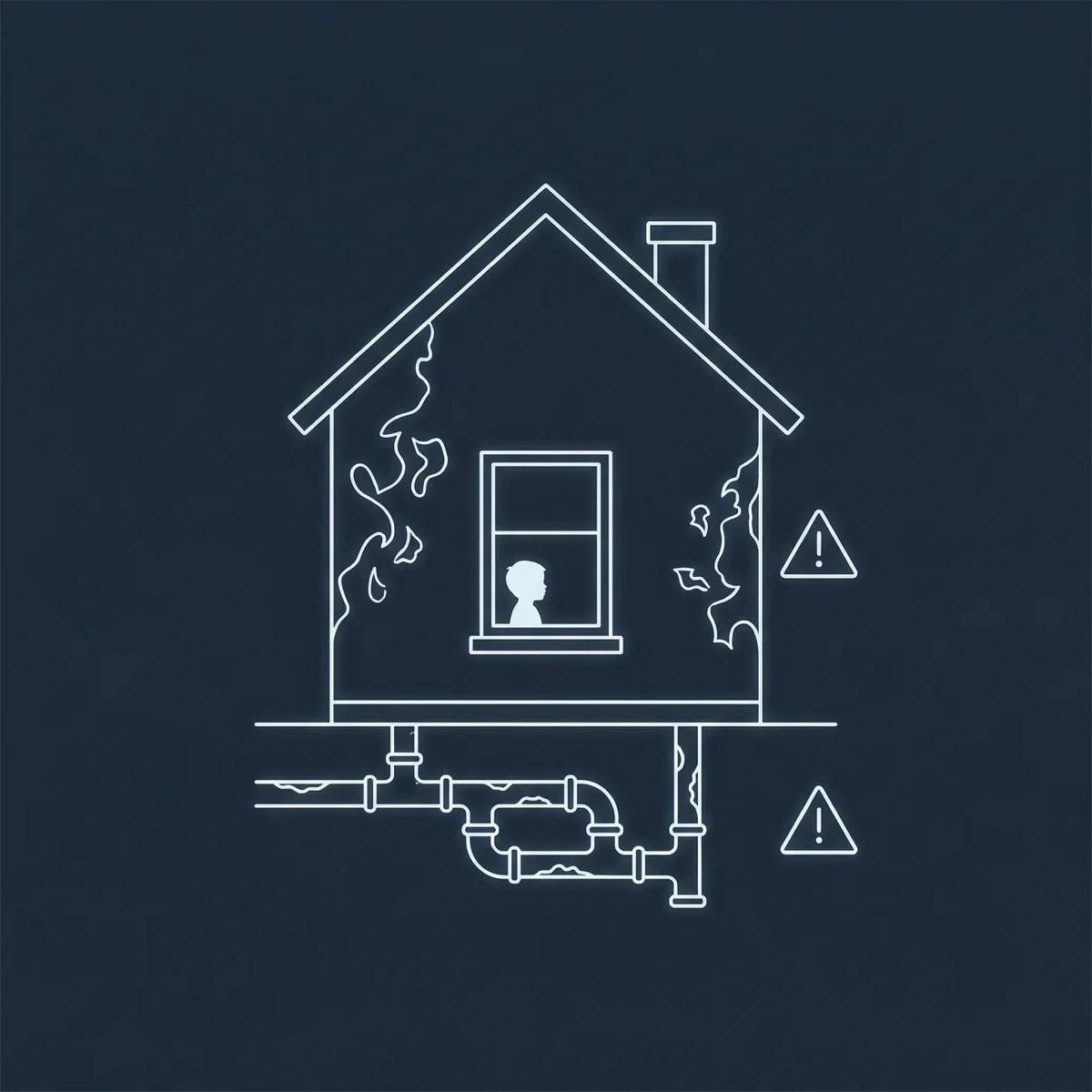
Connecticut has a housing stock problem that most residents don't think about in these terms: the state is old. Not just historically old — structurally old. Approximately 60% of Connecticut homes were built before 1980. That's not a statistic about charm or character. It's a statement about what's in the walls, what's in the pipes, and what may be in the water.
Lead paint was banned for residential use in 1978. Lead solder in plumbing was banned in 1986. Lead service lines — the pipes that connect homes to the water main under the street — were never formally banned, and up to 8,000 of them are still in the ground across Connecticut. This is a statewide issue — Waterbury's soft water makes the problem worse, and even Greenwich's wealthiest neighborhoods have over 1,500 suspected lead lines.
In a pre-1978 Connecticut home, you may have all three.
What Are the Three Sources of Lead in Pre-1978 Connecticut Homes?
Lead paint gets the most attention, and for good reason. Deteriorating lead paint produces lead dust, which settles on floors and surfaces and is ingested by young children who put their hands in their mouths. The CT DPH has a robust lead paint program, and the risks are relatively well-understood by homeowners.
Lead solder gets almost no attention. When copper plumbing was installed before 1986, it was typically joined with solder containing up to 50% lead. That solder is still in millions of Connecticut homes. Water that sits in the pipes overnight — the first draw of the morning — can leach lead from old solder joints, particularly in homes with soft or slightly acidic water.
Lead service lines get attention when there's a news story, then get forgotten. The service line is the pipe that runs from the water main under the street to the shutoff valve inside your house. In homes built before the 1950s, these lines are often lead. In homes built between the 1950s and 1980s, they may be galvanized steel — which can also contain lead deposits from historical contact with lead pipes in the distribution system.
Why the Combination Is Worse Than the Sum
Each of these sources contributes lead to a child's total exposure. The CDC's reference level for blood lead in children is 3.5 micrograms per deciliter — a level at which the agency recommends public health intervention. There is no safe level of lead exposure for children.
The problem with having multiple sources in the same home is that the exposures are additive. A child in a pre-1978 Connecticut home may be getting lead from paint dust, from the morning glass of water (lead solder), and from the water used to make formula or cook food (lead service line). Each source individually might be below the level that triggers a specific intervention. Together, they can push blood lead levels above the reference level.
This is the gap in the current public health approach: lead paint programs and lead water programs operate separately. Nobody is looking at total household lead burden across all sources.
Want to know if lead is in your water? Enter your ZIP code at CheckYourTap.com to see what's in your tap water — free, in 30 seconds.
The Renovation Risk, Again
Renovating a pre-1978 home in Connecticut creates a specific risk that combines both problems. Sanding or disturbing lead paint produces lead dust. Cutting or replacing old plumbing disturbs lead solder and can spike lead levels in the water for weeks after the work is done.
If you're renovating a pre-1978 Connecticut home, you should be doing both: following EPA's Renovation, Repair, and Painting (RRP) rule for lead paint, and running your tap for several minutes after any plumbing work, with a certified lead-reduction filter installed at the kitchen tap.
Most renovation contractors know about the RRP rule. Almost none of them mention the water risk. And the lead exposure risks for children don't stop at home — Connecticut schools have their own lead water problem.
Keep Reading
- Your Waterbury Water Is Soft. That's Actually Why You Should Worry About Lead.
- Greenwich Has 1,500 Suspected Lead Pipes. Wealth Doesn't Buy Better Infrastructure.
- Bridgeport Has the Same Lead Pipe Problem as Flint. Nobody's Calling It That.
Frequently Asked Questions
Can lead paint and lead pipes both be in the same Connecticut home?
Yes. Approximately 60% of Connecticut homes were built before 1980. Lead paint was banned in 1978, lead solder in plumbing was banned in 1986, and lead service lines were installed through the 1950s. A pre-1978 home can have all three sources. The exposures are additive — a child may get lead from paint dust, water from old solder, and water from a lead service line simultaneously, pushing total exposure above safe levels even if each individual source seems low.
How do I know if my Connecticut home has lead pipes?
Check three things: (1) Contact your water utility about your service line — Connecticut utilities are building public inventories required by the EPA. (2) Check visible pipes in your basement — lead pipes are dull gray and can be scratched to reveal shiny silver metal. (3) If your home was built before 1986, assume copper pipes were joined with lead solder. A certified lead-reduction filter at the kitchen tap ($30–$150) addresses both solder and service line risks.
Does renovating an old home increase lead exposure?
Yes. Renovation disturbs both lead paint (creating dust) and plumbing (spiking lead in water). Sanding lead paint produces lead dust that settles on floors and surfaces. Cutting or replacing old pipes dislodges protective scale inside lead solder joints, increasing lead leaching for weeks after the work. Follow EPA's RRP rule for paint, and install a certified lead filter plus flush taps for several minutes after any plumbing work.
Sources: CT DPH Lead Poisoning Prevention Program; EPA Lead and Copper Rule; CT Mirror Lead Service Line Investigation, July 2025; EPA Renovation, Repair, and Painting Rule; CDC Blood Lead Reference Value.