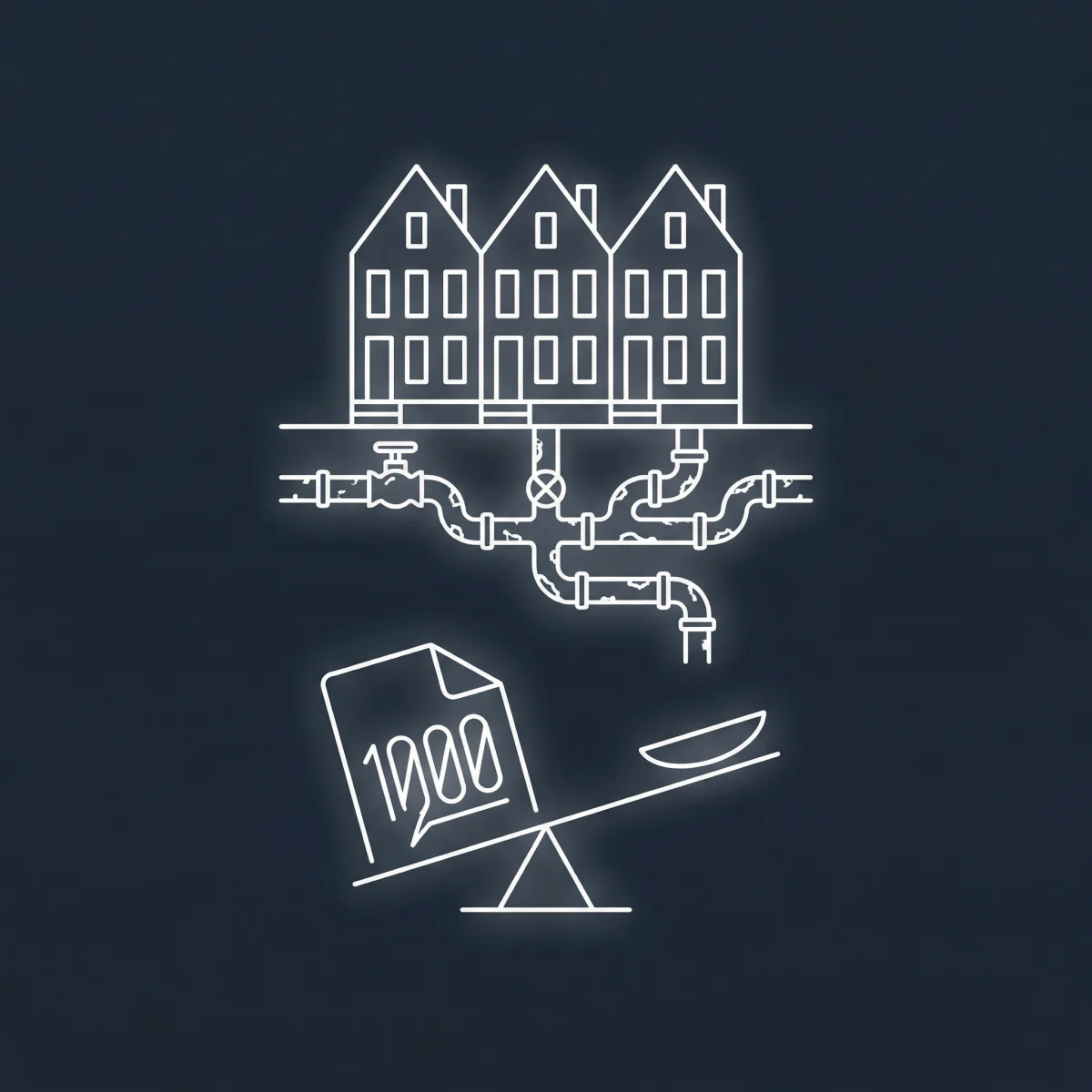
In July 2025, the Connecticut Mirror published what may be the most important piece of water journalism written about this state in a decade. Working with the Pulitzer Center, reporters mapped suspected lead service lines across Connecticut's public water systems. The findings confirmed what public health researchers had long suspected. The lead pipe problem here is not evenly spread. It clusters in the same places poverty clusters, where asthma clusters, where childhood lead poisoning clusters.
Bridgeport sits at the center of that map.
The city has one of the highest concentrations of suspected lead service lines in the state, most of them in the South End, the East Side, and the East End. Those neighborhoods are predominantly Black and Latino. Median household income there runs well below the state average. They are also where homeowners are least able to afford a point-of-use filter or a plumber to inspect a service line.
None of that is coincidence. It's a pattern that shows up in every American city built before 1950 and never fully rebuilt. The pipes serving the poorest neighborhoods are the oldest pipes. The oldest pipes are the ones most likely to be lead.
Does Bridgeport's Water Actually Meet Safety Standards?
When Bridgeport's water utility says the water meets federal standards, they are telling the truth. The city's water system, as measured by the EPA's Lead and Copper Rule sampling protocol, produces results below the 15 parts per billion action level.
Here's what that means in practice. The utility collects samples from a set of "tier 1" sites, meaning homes with known lead service lines or lead plumbing, then calculates the 90th percentile result. If that number lands below 15 ppb, the system is in compliance.
Here's what it does not mean. It does not mean every home in Bridgeport has lead below 15 ppb. It does not mean the water coming out of one particular tap, in one particular house, on one particular block, is safe. The federal standard measures how a system performs on average. It makes no promise about your water.
The same dynamic is playing out in Waterbury, where soft water makes the lead problem worse. A February 2026 Yale School of the Environment study, prompted by the Jackson, Mississippi water crisis, put it plainly: water can comply with federal primary standards and still carry localized corrosion risk. The highest lead levels turned up in first-draw samples, the water that had been sitting in the pipes for hours. The risk tracked conditions inside specific homes, not system-wide averages.
Bridgeport's system average may be fine. The first glass of water you pour on a Tuesday morning in a house built in 1935 on the East Side is a different question.
The Renovation Risk Nobody Mentions
One risk almost never comes up in coverage of lead pipes. Renovation.
Renovating a kitchen or bathroom in a house with lead service lines or lead solder means disturbing the pipes. Cutting, soldering, and replacing sections of old plumbing knocks loose the scale that's built up inside over decades, and that scale can hold lead deposited since the house went up. Lead levels in tap water can spike afterward, sometimes for weeks.
In Bridgeport's South End, where 1910s-through-1940s housing is being renovated as property values climb, that's a real and badly underappreciated risk. People fixing up their homes, which is a good thing and a sign of investment in the neighborhood, may be exposing their families to elevated lead in the weeks right after the work wraps up.
The fix isn't complicated. Run your tap for several minutes after any plumbing work, and use a point-of-use filter certified for lead removal for at least the first month afterward. Most contractors won't mention it. Most homeowners don't know to ask.
What the Federal Money Is Actually Doing
In 2024, the federal government announced $28 million for Connecticut lead pipe replacement, followed by another $25 million from the EPA. That sounds like a lot of money. Then you do the math. Replacing 8,000 lead service lines at an average cost of $5,000 to $10,000 per line means the funding covers somewhere between 3,000 and 5,000 replacements, roughly half the problem if the 8,000-line estimate holds.
The EPA's new Lead and Copper Rule requires utilities to replace all lead service lines within ten years. That rule is currently facing a legal challenge from the American Water Works Association, the country's largest water utility trade group. The challenge argues that the ten-year timeline is too aggressive and too expensive.
For the family on Barnum Avenue, the timeline debate is academic. The pipe is in the ground today.
What Bridgeport Homeowners Should Do Right Now
First: find out if your address is flagged. Connecticut utilities are required to publish their lead service line inventories. Contact Aquarion or the Bridgeport water department and ask specifically about your address. The CT Mirror's investigation found that many residents had no idea their lines were flagged until they were told directly.
Second: filter at the tap. An NSF/ANSI Standard 53 certified filter, either a faucet model or an under-sink unit, is rated specifically to reduce lead. This is not an expensive fix. It's a $30 to $150 investment that removes the risk right where you drink the water.
Third: if you have children under six, or you're pregnant, don't wait. Get a filter in this week. Lead causes irreversible neurological damage in children, and the CDC has confirmed there's no safe level of lead exposure for a developing brain. If your kids attend school in an older building, they may be exposed to lead at school too.
Want ZIP-level context before deciding whether to test? Enter your ZIP code at CheckYourTap.com to see available public-system or regional monitoring records associated with the ZIP. This is not a test of a tap, well, or property. Free, in 30 seconds.
Prefer the local picture first? See what's been detected in Bridgeport's water supply, contaminant by contaminant.
The Flint comparison is uncomfortable, and it isn't perfectly apt. Bridgeport's utility is not actively poisoning the water the way Flint's did when it switched to the Flint River. But the underlying condition rhymes: old pipes, older neighborhoods, a regulatory framework that measures system averages instead of household risk, and a community being told the water is safe when the accurate statement is that the system average is safe.
Those are not the same thing.
Keep Reading
- Your Waterbury Water Is Soft. That's Actually Why You Should Worry About Lead.
- Connecticut Kids Are Still Being Exposed to Lead at School. Flushing the Pipes Isn't a Solution.
- Connecticut Homes Built Before 1978 Have Two Lead Problems. Most Homeowners Only Know About One.
Sources: CT Mirror / Pulitzer Center Lead Pipe Investigation, July 2025; Yale School of the Environment, Water journal, February 2026; EPA Lead and Copper Rule Revisions, 2024; CT DPH Lead Service Line Inventory Data; EPA Drinking Water Infrastructure Grants, 2024.
