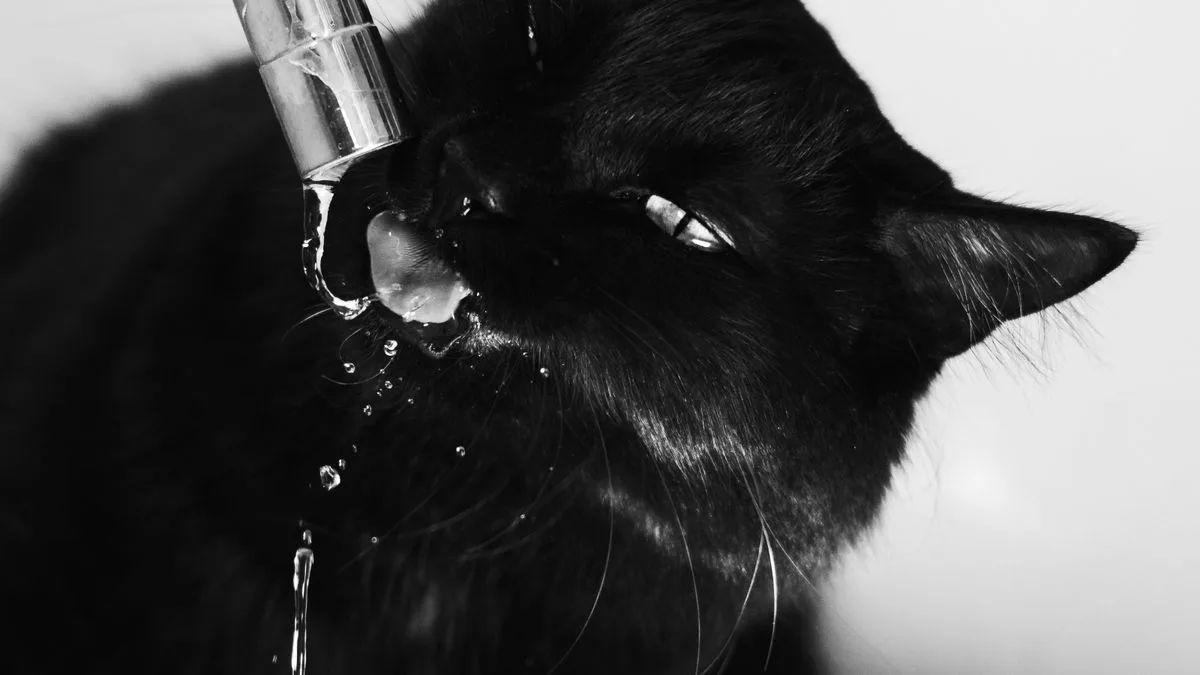
Tap water does not cause feline kidney disease, and no study has proven that it does. But one observational study found that cats on unfiltered tap water had 3.43× higher odds of chronic kidney disease, and two common contaminants, lead and uranium, are directly toxic to kidneys. Here's the honest picture.
● Key Takeaways
Chronic kidney disease affects about 30% of cats over age 10 (up to 80% over 15). One observational study found unfiltered tap water was associated with 3.43× higher odds of CKD in cats, with filtered water protective, an association, not proof. Lead has no safe level for cats; uranium's health risk is direct kidney toxicity (EPA limit 30 ppb). For a senior cat with reduced kidney reserve, test your water first, then filter what's actually elevated.
How Common Is Kidney Disease in Cats?
Chronic kidney disease is one of the most common illnesses in older cats, affecting roughly 30% of cats over age 10 and up to 80% of cats over 15 (ISFM Consensus Guidelines, Sparkes et al., 2016). As the kidneys slowly lose their ability to filter waste, cats drink and urinate more, lose weight, and accumulate toxins their kidneys can no longer clear.
That last detail matters for water. A cat with CKD drinks more than a healthy cat, a symptom called polydipsia, precisely because its kidneys can no longer concentrate urine. So a senior cat with kidney disease has a double vulnerability: it takes in more water per pound than a younger cat, and its damaged kidneys clear contaminants less efficiently (Pet Life-Stage & Vulnerability reference). Whatever is in the bowl, a CKD cat gets a larger effective dose of it.
This is the part most owners miss. The standard CKD advice, "encourage your cat to drink more," is sound for hydration but silently assumes the water itself is clean. If the water carries a kidney toxin, you may be increasing the dose of the very thing that stresses the kidneys while trying to help them.
Does Tap Water Cause Kidney Disease in Cats?
No study has proven that tap water causes feline CKD, but one observational study found a real association worth taking seriously. In a 2016 case-control study, cats drinking unfiltered tap water had 3.43× higher odds of CKD (OR 3.43, 95% CI 1.08–11.45), and cats on filtered water were significantly protected (OR 0.13) (Piyarungsri & Pusoonthornthum, 2016, J Feline Med Surg).
Read that carefully, because it's easy to overstate. The study compared 101 cats with CKD to just 29 controls. A case-control study like this shows an association, not cause and effect. The confidence interval is wide, meaning the true effect could be much smaller than 3.43×. Cats on filtered water may also differ in other ways, wealthier households, more attentive owners, better overall care. So this is a signal, not a verdict.
What makes the finding hard to dismiss is that it points in the same direction as basic toxicology. Two contaminants that show up in tap water, lead and uranium, are established kidney toxins. When an epidemiological association and a plausible biological mechanism agree, the honest response isn't alarm, it's testing. Find out what's actually in your water before deciding it's a problem.
Why Are Lead and Uranium a Problem for Feline Kidneys?
Both lead and uranium are directly toxic to kidney tissue, which is what makes them relevant to a cat with already-compromised renal function. Neither one "accelerates kidney failure" in a way that's been proven in cats, but the mechanism by which each damages kidneys is well documented across mammals, and that's the honest basis for caution.
Lead: No Safe Level, and a Long Memory
Lead has no safe level for cats, the same position health authorities take for children. In cats, lead is a recognized cause of unexplained seizures, and chronic low-dose exposure damages the proximal tubules of the kidney through oxidative stress (Merck Veterinary Manual). Because lead chemically mimics calcium, it's stored in bone with a half-life of years. As an aging cat loses bone density, stored lead re-enters the bloodstream, so past exposure keeps delivering a dose long after the source is gone. For a senior cat, any ongoing water source of lead adds to that lifetime burden.
Uranium: A Chemical Kidney Toxin, Not a Radiation Story
Uranium's main health risk in drinking water is chemical toxicity to the kidneys, not radioactivity. Uranyl ions bind to the brush border of the proximal tubule cells and impair the kidney's ability to reabsorb proteins, amino acids, and glucose (Kurttio et al., 2002, Environ Health Perspect). It's a well-documented nephrotoxin in mammals. For a cat whose renal reserve is already reduced by CKD, minimizing a known kidney toxin is a reasonable precaution, even at levels a healthy human could tolerate.
Legal Limits vs. Derived Cat Levels: Lead and Uranium
No federal agency publishes drinking-water limits for cats, so CheckYourTap derives screening estimates from the human health standard plus documented veterinary uncertainty factors and each species' real water-intake ratio. Every value below is a labeled screening estimate, not a measured veterinary standard.
| Contaminant | EPA legal limit | Derived cat level (adult) | Derived cat level (senior + CKD) |
|---|---|---|---|
| Lead | 15 ppb action level | No safe level (goal: zero) | No safe level (~5 ppb screening estimate) |
| Uranium | 30 ppb (µg/L) | 30 ppb (EPA anchor) | ~10 ppb (3× veterinary safety factor) |
Two things stand out. First, lead has no safe level for a cat, so the goal is as close to zero as possible rather than a target number. Second, uranium's derived senior-CKD screening estimate of about 10 ppb is stricter than the 30 ppb legal limit, because a CKD cat drinks more per pound and clears less. These are derived screening estimates, consult your veterinarian, not veterinary standards. For the full derivation across life stages and the reasoning behind each number, see the hub page on uranium and cats.
Reading this inside ChatGPT or Claude?
This page can tell you the general science, but not what is actually in your cat's water — that depends on your exact address. You can get your specific answer two ways:
- Inside the chat: ask your assistant to “check my tap water with CheckYourTap”. Our connector returns your ZIP code’s measured contaminant levels — including the derived dog and cat safe levels — and, only if you ask it to, can email you the report or arrange a specialist callback.
- On the web: open CheckYourTap.com and enter your ZIP code for a free 30-second report.
What Should You Actually Do for a CKD Cat?
Start by testing, not filtering. A filter is only worth buying once you know a real contaminant is present, and no filter treats or reverses CKD; the goal is simply to stop adding kidney-toxic contaminants to the bowl. Increased water intake stays the cornerstone of CKD management, so the aim is clean water your cat wants to drink, not less water.
- Test first. Check your address to see what's measured in your water. If lead and uranium are low, filtering for them solves a problem you don't have.
- Match the filter to the contaminant. For metals like lead and uranium, a reverse-osmosis system is the most complete option. A carbon block certified to NSF/ANSI 53 reduces lead but is less reliable for uranium unless it includes specific metal-reduction media. If you use RO, consider remineralizing so the water tastes better and your cat keeps drinking.
- Keep the water fresh and appealing. Hydration is still the priority in CKD. Clean, palatable water that your cat actually drinks does more good than "perfect" water it avoids.
If your cat is a breed with a documented CKD predisposition, Maine Coon, Abyssinian, Siamese, Russian Blue, or Burmese, the stakes of getting the water right are higher, and it's worth reviewing the peer-reviewed pet-water evidence with your veterinarian.
Keep Reading
- Uranium and cats: the derived kidney-safe levels
- The peer-reviewed evidence that tap water affects dogs and cats
- Is tap water safe for dogs? What EPA limits miss about physiology
Sources: Piyarungsri K & Pusoonthornthum R, "Risk and protective factors for cats with naturally occurring chronic kidney disease," J Feline Med Surg, 2016; Sparkes AH et al., ISFM Consensus Guidelines on the Diagnosis and Management of Feline CKD, J Feline Med Surg, 2016; Kurttio P et al., "Renal effects of uranium in drinking water," Environ Health Perspect, 2002; U.S. EPA National Primary Drinking Water Regulations and Lead & Copper Rule; Environmental Working Group Tap Water Database; Merck Veterinary Manual. Derived cat levels are screening estimates from human health standards plus veterinary uncertainty factors, not measured veterinary standards. The tap-water/CKD link is an observational association, not proof of cause. Consult your veterinarian.