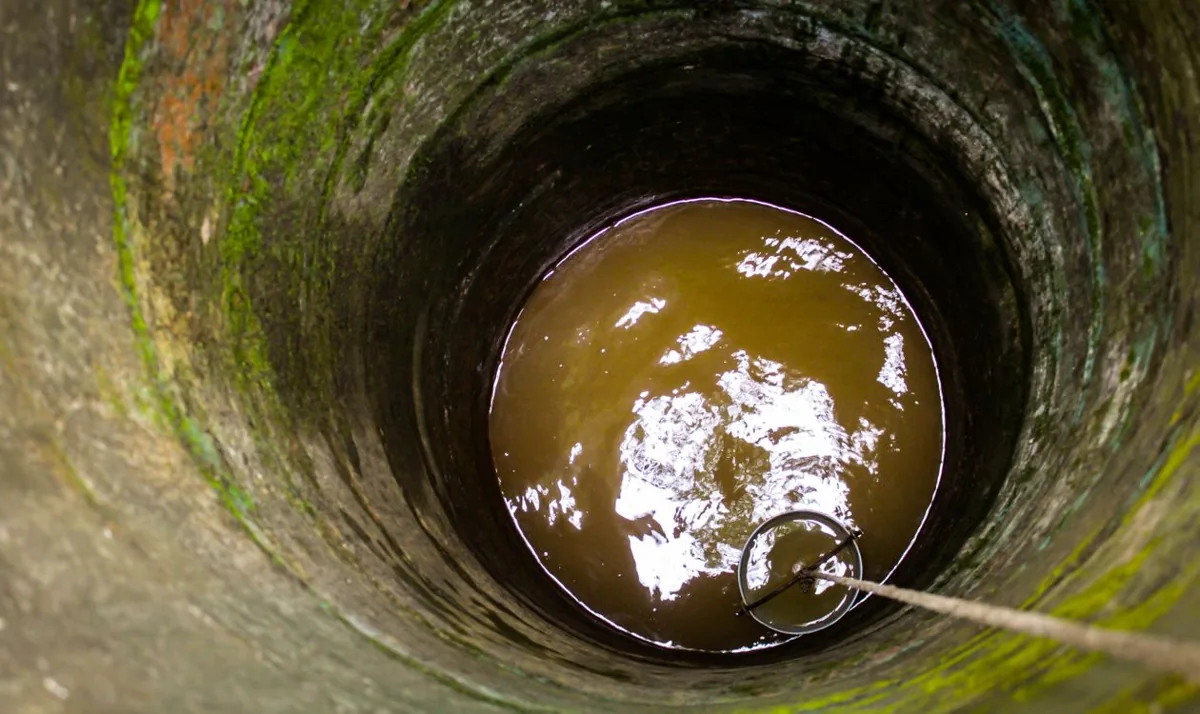
Private wells are unregulated by design, so no live database exists for any individual well. What is stable is bedrock. A town's rock predicts what its wells tend to contain, and these historical USGS samples (median year ~1972) corroborate it. Hard water causes hair breakage, not baldness.
● Key Takeaways
Private wells are unregulated by design. Nobody tests them on a schedule, so there is no live public database for any individual well, and there never will be. What's stable and knowable is the bedrock a well draws from. Rock doesn't change on a human timescale, so a town's geology reliably predicts what its wells tend to contain, and these historical USGS samples (median year ~1972) corroborate that geology. Hardness and naturally occurring arsenic are rock-driven and stable. Nitrate drifts with land use. Hard water causes hair breakage (~8% tensile-strength loss in one study), not hair loss at the root. Geology tells you what your town predisposes your well to. Only a test tells you your specific well.
What these wells are. These are groundwater wells in the USGS and state sampling record. Our source data does not record whether a given well supplies a household's drinking water, so we say "wells" rather than "private wells." USGS classifies only 13 of Connecticut's 6,358 groundwater sites as dedicated monitoring wells, so these are ordinary wells rather than pollution-monitoring wells. They are also wells that happened to get tested, not a random sample of the state.
Why "Historical" Doesn't Mean "Outdated" Here
Public water systems get tested on a legal schedule. Private wells don't, by design. A private well is private property, and no agency samples it for you. In Connecticut, where more than 300,000 households drink from private wells, there is no live public database for any individual well, and there never will be. That's the nature of well ownership, not a hole in anyone's data. The multi-decade record collected by the U.S. Geological Survey is actually the most complete long-run picture of Connecticut well chemistry that exists.
It's also more useful than its age suggests, for one reason. The bedrock a well draws from doesn't change on a human timescale. Water hardness, along with the natural presence of arsenic and uranium that comes straight out of the rock, is set by whatever the groundwater flows through. That rock was there long before the first sample and will be there long after the last. So a hardness reading from 1978 isn't stale. It corroborates the geology, and the geology is the stable, predictive part.
Where the data splits:
- Hardness and rock-derived metals are stable. These historical readings still reflect what a town's wells tend to contain, because the aquifer's rock hasn't changed. Hardness is the through-line of this ranking.
- Nitrate is land-use-driven and can drift. Nitrate tracks septic density, fertilizer, and land use, so old nitrate numbers are dated context. Read them as history, then confirm with a test.
The median sample year here is about 1972. Three towns (Southbury, Bristol, and East Windsor) carry recent 2017 readings. Even the older rows, though, are anchored to geology that hasn't moved. What a test adds is the one thing geology can't give you: your specific well. Its depth, its construction, and the exact rock it taps all vary house to house.
Why Bedrock Geology Decides Your Well Water
Groundwater is only as clean as the rock it flows through. CheckYourTap maps every Connecticut ZIP to its underlying bedrock using the CT DEEP Bedrock Geology map (point-in-polygon), and the towns on this list fall into two clean geologic stories.
Hard water is a carbonate-and-basin story
The minerals that make water hard, calcium and magnesium, weather out of carbonate and sedimentary rock.
- The central Connecticut / Hartford basin is built from arkose sandstone and basalt "traprock" (rock units like the New Haven arkose, the Portland arkose, and the Holyoke and East Berlin basalts). Hartford, Berlin, East Berlin, East Windsor, Hamden, and Southbury sit on this basin, and it hands their wells hard water.
- The western marble valley runs on Stockbridge marble, a carbonate rock that dissolves readily into groundwater. Kent, plus the Falls Village and Canaan valley, draw from it. That's why their water tests very hard.
Rock doesn't age, so a town's hardness tendency holds. That's exactly why the historical hardness readings still reflect the aquifer today, and why hardness is the through-line here. The hard-water-heavy towns (Kent, Falls Village, Southbury, Bristol, Fairfield) are the breakage story: more mineral settling on the hair shaft, more brittle strands. Not baldness.
Arsenic and uranium are a crystalline-highland story
Arsenic and uranium can occur naturally in crystalline highland rock, meaning gneiss and granite. Arsenic is the hair-relevant one here.
- The western crystalline highlands stand out for arsenic. Goshen in particular sits on bedrock that shows the state's highest modeled arsenic and uranium tendency. Danbury and Ridgefield show a uranium tendency.
- The Hartford-basin arkose (the Portland unit) carries a moderate arsenic tendency, which layers onto the hard-water towns of Hartford, Berlin, East Berlin, and East Windsor.
One rule governs how to read this: bedrock is a reason to test, not a probability. "Wells on this rock type across Connecticut tend to test higher for arsenic" is a tendency. It doesn't tell you the odds for your particular well, and the share of wells that actually exceed a limit is much smaller than the raw geologic signal suggests. So treat a high natural tendency as an instruction rather than an alarm: test for exactly that contaminant. For Goshen and the crystalline-highland towns, that means testing for arsenic and uranium, calmly, in advance.
The Ranking (Every Value Shows Its Sample Year)
USGS hardness classes: soft under 60, moderate 60 to 120, hard 120 to 180, very hard above 180 mg/L as CaCO₃ (USGS hardness of water). Rank reflects tiered hair-loss relevance: hard water (Tier A, causes breakage) plus nitrate and arsenic (Tier B co-factors). Read the year next to every value. It is doing as much work as the number.
| Rank | Town | Hardness (mg/L) | Sample yr | Other historical finding | Yr |
|---|---|---|---|---|---|
| 1 | Fairfield | 240 (very hard) | 1978 | Nitrate 13.3 mg/L (above the 10 limit) | 1966 |
| 1 | Falls Village | 249 (very hard) | 1995 | Nitrate 22.0 mg/L | 1995 |
| 1 | Ridgefield | 398 (very hard) | 1984 | Nitrate 16.0 mg/L | 1984 |
| 1 | Southbury ✅ recent | 254 (very hard) | 2017 | Nitrate 15.2 mg/L | 2017 |
| 5 | Bristol ✅ recent | 636 (very hard) | 2017 | no data | no data |
| 5 | East Berlin | 1500 (very hard) | 1972 | no data | no data |
| 5 | Danbury | 363 (very hard) | 1993 | no data | no data |
| 5 | Hartford | 360 (very hard) | 1957 | no data | no data |
| 5 | Hamden | 250 (very hard) | 1995 | no data | no data |
| 5 | East Windsor ✅ recent | 247 (very hard) | 2017 | no data | no data |
| 5 | Kent | 247 (very hard) | (year not recorded) | no data | no data |
| 5 | Goshen | 240 (very hard) | 1968 | no data | no data |
| 5 | Berlin | 213 (very hard) | 1993 | no data | no data |
| 5 | Ellington | 216 (very hard) | 1994 | no data | no data |
The caveat again, because it matters: these are historical USGS well samples, not current tap results. A 1957 Hartford reading, or a 1966 Fairfield nitrate value, tells you about that town's groundwater chemistry in that era. Hardness has likely persisted. The old nitrate figures may have risen or fallen. ✅ marks the three towns whose readings are recent enough (2017) to trust most. Source: CheckYourTap water quality data (historical USGS well samples).
What Hard Water Actually Does to Hair (Breakage, Not Baldness)
This is where most "hard water and hair loss" content goes wrong, and where getting it right is the whole point.
Hard water does not make hair fall out at the follicle. It causes breakage. Calcium and magnesium settle onto the hair shaft over repeated washes, and that mineral film leaves strands stiffer, rougher, and more brittle, so they snap mid-shaft. The result looks like thinning, because you keep finding broken hairs. The root is untouched.
The evidence is genuinely mixed, and it would be wrong not to say so. A 2018 study found roughly an 8% loss of hair tensile strength (P=0.001) after three months of hard-water washing (PubMed 30034190). An earlier 2013 study found no significant effect (P=0.858). So the strongest defensible claim is this: hard water can measurably weaken hair strands under some conditions, making breakage more likely. That's a cosmetic, reversible problem, not true hair loss. We cover the full picture in the real science of hard water and hair loss in CT.
The two Tier-B contaminants are weaker and more roundabout. Nitrate above its 10 mg/L limit slightly blocks the thyroid's iodide uptake, the step it needs to make hormone, and it's far weaker at this than perchlorate. So the thyroid-to-hair link there is biological plausibility, not proven cause. Arsenic is associated with hair changes at high, long-term exposure (EPA limit 10 µg/L). The historical nitrate and arsenic numbers above are context, not a verdict on today. See our contaminant hubs for arsenic and nitrate.
Is My Well Still Like This? (You Can Only Know by Testing)
If your town is on the list, the straight answer is that we don't know what your well contains today, and neither does anyone else until it's tested. A ranking built on a 1972 median cannot tell you your 2026 water.
What we can say with reasonable confidence is that hardness tends to persist, because the bedrock hasn't changed. If Ridgefield's wells were very hard in 1984, the geology behind that is still sitting there. Nitrate and arsenic are the wild cards. They could be higher or lower now, depending on decades of land use around your specific well.
Connecticut does not test private wells for homeowners. That job is yours, and it's the whole reason this post exists: to point you toward a real measurement, not to hand you a decades-old number to stew over. Expecting a baby, or have young children at home? Move it up your list, and see well-water testing for newborns.
We Also Checked the Real Hair-Loss Toxins, and CT Wells Are Clean on Those
We should also tell you what we didn't find. Two elements genuinely can cause hair loss at high dose, selenium and thallium, so CheckYourTap screened Connecticut wells for both.
- Selenium in CT wells maxes out around 1 µg/L, against a safe limit of 50 µg/L. That's roughly a 50× margin, nowhere near the level that affects hair (selenium's safety margin in CT water).
- Thallium shows up only in trace amounts, well within legal limits (thallium at the legal limit is safe).
So neither of the two elements most credibly tied to water-driven hair loss is elevated in Connecticut groundwater. We looked. They're not the story here. Hardness is, and hardness is a breakage issue rather than a baldness one.
What To Do
- Start with ZIP-level records, then confirm the property. Check available records associated with your ZIP. The report does not identify your serving utility or test your tap, well, or property; use a certified property sample before making treatment decisions.
- Match the fix to the finding. For high hardness, a water softener, or reverse osmosis if you also want the minerals out of your drinking water. For elevated nitrate or arsenic, reverse osmosis is the most complete option (what reverse osmosis removes in CT).
- For hair specifically, a shower filter and a chelating shampoo cut down the mineral left on the shaft. That only helps if hardness is actually your problem, which a test confirms.
This is why CheckYourTap publishes a number for a body, not just a legal limit, and starts with Connecticut. A decades-old regional statistic is a starting question. Your own well test is the answer.
Reading this inside ChatGPT or Claude?
This page can explain the general science about your well water, but it cannot identify what is at a specific tap or property. You can get ZIP-level context two ways:
- Inside the chat: ask your assistant to “check my tap water with CheckYourTap”. Our connector returns available public-system or regional monitoring records associated with your ZIP. It does not identify your serving utility or test your tap, well, or property. The current connector is read-only and does not email reports or submit contact information.
- On the web: open CheckYourTap.com and enter your ZIP code for a free ZIP-level report.
Keep Reading
- Hard water and hair loss in CT: the real science
- Selenium in water: the safety margin that matters
- Thallium at the legal limit is safe
- Well-water testing for newborns: 7 contaminants
Sources: CheckYourTap water quality data (historical USGS private-well groundwater samples; median sample year ~1972, ~16% since 2015). USGS Water Science School, hardness of water. Hard-water hair studies: PubMed 30034190 (2018, ~8% tensile-strength loss, P=0.001) and a 2013 study finding no significant effect (P=0.858). EPA Maximum Contaminant Levels: nitrate 10 mg/L as N, arsenic 10 µg/L. This is general information, not medical advice. For hair loss or a health concern, consult your provider. For your water, test your well.
