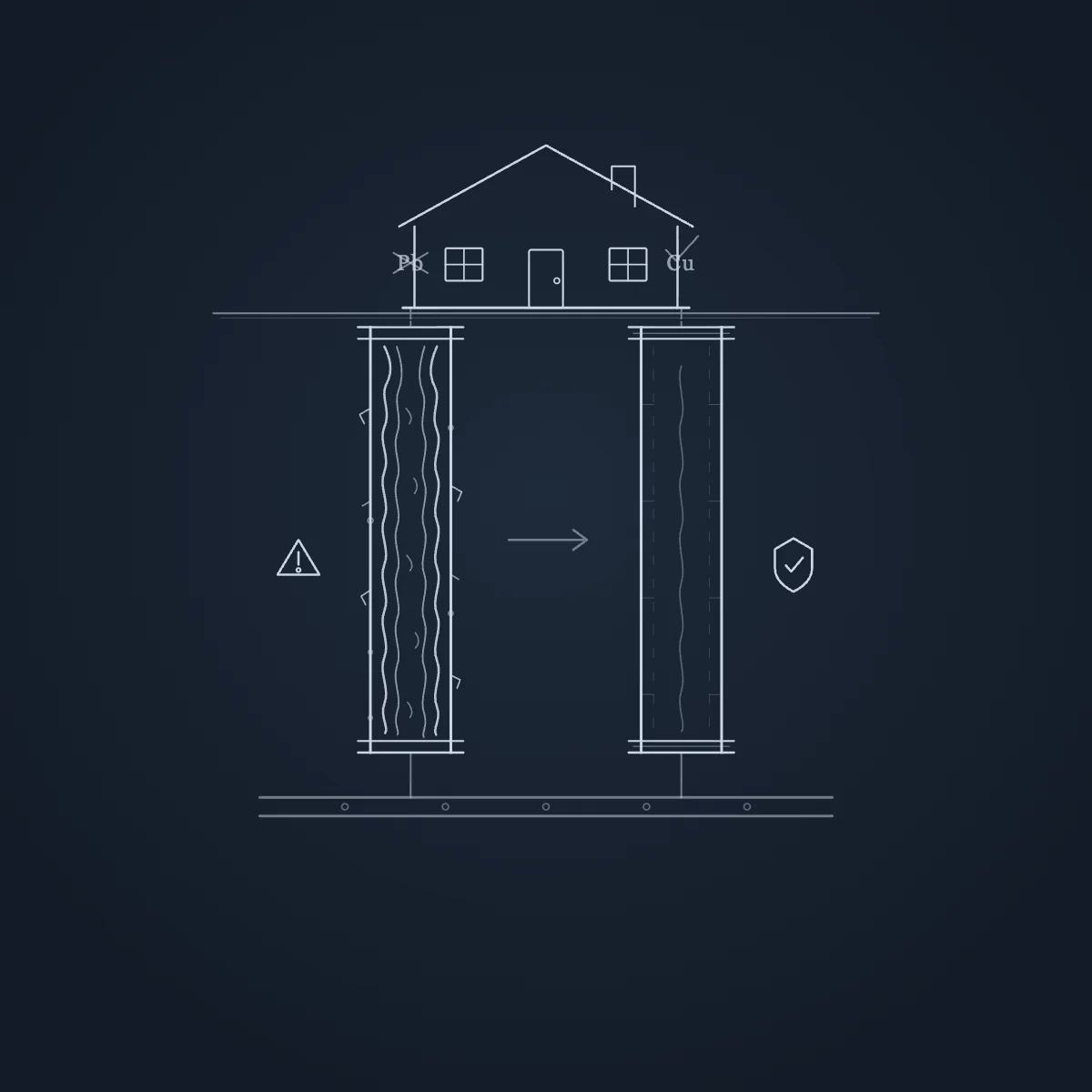
Up to 8,000 lead pipes still deliver drinking water to Connecticut homes. You might live in one of them and not know it.
The EPA's Lead and Copper Rule Revisions, finalized in October 2024, now force every utility in the state to find these aging connections, notify affected homeowners, and replace them within 10 years. But the math doesn't add up. CT received $53.55 million in federal funding last year. At an average cost of $12,500 per replacement, that covers roughly 4,300 homes. The remaining pipes? Someone else pays.
The clock started ticking in October. Utilities had to submit complete inventories by October 16, 2024, mapping every connection down to your property. Some already knew where the contamination risk was. Others are still guessing. The difference matters when you're the one drinking from it.
How Many Lead Service Lines Does Connecticut Have?
The problem isn't evenly distributed. The state has up to 8,000 remaining lead connections, according to CT Mirror's July 2025 investigation. Three regions carry most of the burden.
| Utility / Region | Estimated Lead Lines | Inventory Status | |-----------------|---------------------|-----------------| | Aquarion (Fairfield County) | ~4,000 | Under inspection | | Greenwich | 1,500+ suspected | Under inspection | | MDC (Greater Hartford) | 14% unknown/confirmed | 86% verified lead-free | | Regional Water Authority (New Haven + 14 towns) | 7% of 125,000+ | 93% verified lead-free |
Aquarion serves Fairfield County with roughly 4,000 estimated contaminated connections, concentrated in Bridgeport's older neighborhoods. That's half the state's total in one service area. Bridgeport's crisis maps directly onto income brackets: the aging infrastructure clusters where property values stayed low for decades.
Greenwich tells a different story. The wealthy coastal town has 1,500+ suspected lines, because housing age beats affluence. Construction before 1950 used lead as standard plumbing practice, whether in working-class Bridgeport or estate-lined Greenwich avenues. Greenwich's infrastructure challenge proves that pipe material correlates with building era, not zip code wealth.
The Metropolitan District Commission serves Greater Hartford with better numbers. They've confirmed 86% of their connections are lead-free. But 14% remain unknown or confirmed positive. "Unknown" means they haven't inspected yet, or records don't exist.
Regional Water Authority, covering New Haven and 14 surrounding towns, reports 93% of 125,000+ connections verified clean. That still leaves thousands unaccounted for. "Unknown" becomes your problem when you're buying a house or filling a sippy cup.
The pattern cuts across economic lines. Low-income neighborhoods in Bridgeport face exposure from infrastructure never upgraded. But so do $2 million homes in Greenwich's old-money districts. CheckYourTap's database shows contaminated pipes in census tracts with median incomes below $40,000 and above $150,000. The plumbing doesn't discriminate by wealth. It discriminates by age.
What Changed? The EPA's Lead and Copper Rule Revisions
The EPA finalized its LCRI in October 2024, tightening standards after decades of incremental failure. The action level dropped from 15 parts per billion to 10 ppb — a 33% reduction that instantly reclassified compliant systems as at-risk.
CT utilities faced their first hard deadline on October 16, 2024: submit complete inventories of every connection. That means tracking pipe material from the main under the street to the shut-off valve inside your basement. Providers that kept sloppy records for 70 years suddenly had to account for hundreds of thousands of hookups.
The rule sets a mandatory 10-year replacement timeline running from 2027 to 2037. No extensions. No exceptions for budget shortfalls. If a utility identifies a contaminated connection, they have a decade to rip it out and install copper or plastic. Partial replacements no longer count. The EPA finally acknowledged what researchers proved in 2011: replacing only the public-side pipe can temporarily spike contamination by disturbing sediment.
Notification requirements now include three triggers. Within 30 days of inventory completion, utilities must tell you if your connection contains lead. Annual notices go to homes with unknown pipe material until someone inspects. And if levels exceed 10 ppb in your tap, you get a Tier 1 notice within 24 hours — the same urgency tier as E. coli contamination.
Post-replacement obligations shifted to providers. After pulling out a contaminated line, the utility must deliver an NSF/ANSI 53-certified pitcher filter and six months of replacement cartridges. Free. That covers the transition period while disturbed sediment clears the system.
The LCRI's political future remains unclear. The rule took effect under Biden, but litigation continues. Court briefings conclude in January 2026, according to National League of Cities analysis. Some utilities worry about rollbacks. Most continue compliance because the infrastructure funding already flowed. You can't un-allocate $53.55 million.
Regulatory uncertainty doesn't stop metal from leaching. Whether the rule survives or gets revised, 8,000 contaminated pipes remain physical reality. Our data shows the infrastructure in the ground doesn't care about federal politics. This parallels the PFAS surcharge story: federal rules create compliance costs, utilities pass them to ratepayers, and homeowners absorb the risk during implementation delays.
Why Lead in Water Matters: The Health Case
No safe threshold exists. The CDC and EPA agree on this point. Even single-digit exposures damage developing brains.
The state tested 72,190 children for blood lead in 2024. Of those, 1,887 showed elevated levels at or above 3.5 micrograms per deciliter, according to the CT DPH 2024 Lead Surveillance Report. That's 2.6% of tested kids carrying measurable burden.
Racial disparities compound the problem. Non-Hispanic Black children test positive at 2.3 times the rate of white children: 2.9% versus 1.3%. The difference maps to housing age and maintenance, not biology. Older homes concentrate in historically redlined neighborhoods — the same neighborhoods that got contaminated plumbing installed first and replaced last.
Children absorb four to five times more than adults from the same exposure. Their developing nervous systems pull the metal from the gut more efficiently. Their smaller body mass means lower absolute doses create higher blood concentrations. And their brains remain vulnerable through age six, exactly when they're drinking from sippy cups and eating food prepared with tap water.
When present, these pipes contribute 50% to 75% of total lead in drinking water, per EPA data. Corrosion releases particles continuously. Chemistry matters: soft water strips more metal than hard water. Waterbury's unusually soft supply makes its pipe problem worse because low mineral content acts like a solvent on aging plumbing.
Tap water accounts for 20% of total exposure in typical scenarios. But for formula-fed infants, that jumps to 40% to 60%. Mix powdered formula with contaminated tap three times daily, and drinking becomes the primary route of harm.
Paint remains the state's number one source. The 2024 surveillance report shows 76% of investigated homes had paint hazards. Pipes rank as one contributor among several. But "not the biggest source" doesn't mean "safe to ignore." CT children face double exposure when both paint and plumbing contain the metal. The effects stack.
Schools add another layer. Children spend seven hours daily drinking from fountains and filling bottles. A contaminated line feeding the school building exposes hundreds of kids simultaneously. Testing protocols vary by district. Some test annually. Others wait for problems.
The health case isn't abstract. It's 1,887 children with elevated blood lead in 2024, disproportionately Black, disproportionately poor, drinking from infrastructure installed when Truman was president.
How to Check If Your Home Has Lead Pipes
You can identify suspect plumbing yourself in 15 minutes. Start with documentation, then verify physically.
Check your utility's inventory first. Every CT provider submitted inventories by October 16, 2024. Most publish lookup tools on their websites. Enter your address. They'll tell you "lead," "lead-free," or "unknown." Unknown means they haven't inspected or lack records. Treat it as "possibly contaminated" until proven otherwise.
CT Mirror built an address lookup tool at ctmirror.org/2025/07/28/ct-lead-pipes-address-lookup. It aggregates utility data statewide. Faster than hunting through 60 separate provider websites.
Visual inspection works if you can access the entry point. Find where the line enters your home — usually in the basement near the meter. Here's how to identify the material:
| Test | Method | Lead Result | Copper Result | Galvanized Steel Result | |------|--------|------------|---------------|------------------------| | Visual | Look at color and joints | Dull gray, bulged joints | Reddish-orange | Gray, threaded joints | | Scratch | Coin on surface | Shiny silver underneath | Reddish-orange underneath | Bright metallic sheen | | Magnet | Hold to pipe | Falls off | Falls off | Sticks |
Some pipes hide behind finished walls. You might only see the connection at the shut-off valve. If you can't access the entry point, you have three options: contact the utility for an inspection appointment, hire a licensed plumber, or default to protective measures while assuming the worst until proven otherwise.
Contact your provider directly if databases show "unknown." They'll send an inspector. Free. Part of the LCRI mandate. They document findings and update the official inventory. Get it in writing.
Pre-1950 construction carries highest risk. Lead was standard installation material until the 1950s. Some utilities kept installing it into the 1970s. Construction year narrows the odds but doesn't eliminate them. Our database shows contaminated connections in homes built through 1986, when federal law finally banned the material in plumbing.
Partial replacements create hidden risk. If the prior owner replaced the section from the house to the property line but the utility didn't replace the public section, you've got a mixed-material connection. Check both sides of the property line.
You're looking for a dull gray pipe, soft enough to scratch, non-magnetic, roughly ¾ inch diameter, entering your basement near the meter. If you find it, you've confirmed what 8,000 CT households already know. Now you decide what to do next.
Who Pays for Replacement, and How Much Does It Cost?
Full replacement averages $12,500 per home nationally, according to EPIC's infrastructure analysis. CT costs track close to that figure. But the range spans $2,096 to $33,408 depending on conditions, per NRDC's cost study.
Depth matters. A service line buried six feet down costs more to excavate than one at three feet. Landscaping matters: concrete driveways, brick patios, and mature tree roots add thousands. Urban density matters: tight lot lines and underground utilities complicate access. The $12,500 average assumes standard suburban conditions. Your actual cost varies.
The state received $53.55 million in federal funding during 2024 alone. The EPA announced $28.65 million in May and $24.9 million in October. Both came through the Drinking Water State Revolving Fund, part of the Bipartisan Infrastructure Law's $15 billion national allocation.
The White House fact sheet specifies 49% of infrastructure funding gets provided as grants or principal forgiveness. That means roughly half comes as free money. The other half arrives as low-interest loans utilities must repay.
Do the math. $53.55 million divided by $12,500 per replacement equals 4,284 homes. The state has up to 8,000 contaminated connections. The 2024 funding covers 54% of the problem. Someone pays for the rest.
New London offers a case study. The city received a $6.9 million loan with $4.4 million in principal forgiveness to replace roughly 150 contaminated connections. That's $46,000 per replacement — well above the national average. Coastal conditions and dense urban infrastructure drove costs higher. The forgiveness covered 64%. The city borrows the remaining $2.5 million, then repays through rates.
Partial replacement creates a worse problem temporarily. If the utility swaps only the public-side pipe (main to property line) but leaves your private-side pipe (property line to house), you get a galvanic junction between dissimilar metals. That junction corrodes faster. Contamination can spike for months. NRDC and EPA research confirmed this in multiple studies. The LCRI now requires full replacements: both sides, same project.
Who pays the private-side cost varies by provider. Some use grant money to cover the entire job at no cost to homeowners. Others split: utility handles public infrastructure, homeowner covers private property. Some offer payment plans or second-tier low-interest loans. Policy varies across the state's 60+ systems.
Aquarion, Connecticut Water Company, and Regional Water Authority each set their own cost-sharing policies. MDC's policy differs from Greenwich's. Contact your specific provider — don't assume statewide consistency. Ask two questions: "Will you replace my private-side pipe?" and "Do I pay anything?"
Funding comes in cycles. The 2024 allocation won't be the last. The Bipartisan Infrastructure Law stretches through 2026. Additional tranches will follow. But timing matters. If your provider schedules replacement for 2035, you're drinking from contaminated plumbing for another nine years while waiting.
The 10-year mandate means utilities must average 800 replacements annually to hit 8,000 by 2037. Current funding covers four to five years at that pace. Gap years mean ratepayer-funded projects or delayed schedules. Either homeowners pay directly, or everyone pays through rate increases.
What to Do Right Now If You Have Lead Pipes (or Don't Know)
Identify your pipe material immediately. Follow the inspection steps above: check the utility inventory, scratch test the visible pipe, run the magnet test. If results show "unknown" or you can't access the entry point, assume contamination until proven otherwise. Being wrong costs nothing. Being right costs your child's cognitive development.
Flush cold tap for five minutes minimum if plumbing sat unused for six hours. Overnight stasis lets the metal leach into standing water. Morning first-draw samples show highest concentrations. Run until temperature stabilizes (about five minutes). Use flushed water for plants, not drinking. Yes, this wastes water. Exposure wastes brain cells.
Always use cold tap for drinking and cooking. Hot dissolves more contaminant from pipe surfaces. Don't cook pasta in hot tap. Don't make coffee with it. Heat after drawing cold. The temperature difference matters: 140°F can leach twice as much as 60°F.
Install an NSF/ANSI Standard 53 certified filter. Look for that exact certification — Standard 53 specifically covers lead removal. Generic "water filters" don't count. Certified pitchers cost $30 to $60. Faucet-mount models run $50 to $150. Under-sink systems range $150 to $400. PMC filter research confirms properly maintained units remove 96%.
Replace cartridges on the manufacturer's schedule. Expired filters release accumulated contaminant back into your supply. That's worse than no filter. Mark replacement dates on your calendar. Set phone reminders. Cartridges typically last two to three months depending on usage volume. Ignore the "or 40 gallons" guidance. Use time.
Contact your provider about replacement programs today. Get on the list. Ask three questions: When is my replacement scheduled? Do I pay anything? Can I move up the timeline if I cover the private-side cost? Some providers prioritize homes with children under six or pregnant women. Provide documentation if you qualify.
Test your tap if you have specific concerns. Most utilities offer free or low-cost testing. CT DPH provides testing information by region. First-draw samples (sitting overnight) show maximum exposure. Flushed samples show baseline. Test both. Results above 5 ppb warrant immediate filter installation. Results above 15 ppb trigger mandatory notification under the old rules, 10 ppb under LCRI.
Reverse osmosis systems remove 95%+ but cost $200 to $500 installed. Overkill for most homes. Standard pitcher filters work fine if you replace cartridges.
Pregnant women face elevated risk. The metal crosses the placental barrier. Fetal brain development occurs during first trimester when many women don't yet know they're pregnant. If you're trying to conceive, treat this as a preconception risk, not just a pregnancy concern.
Don't drink from the hose. Garden hoses contain lead in brass fittings even if your plumbing is clean. Kids filling water balloons or drinking during yard work get direct exposure. Use indoor taps only.
Don't boil it out. Boiling concentrates dissolved metals. It evaporates volume, leaving contaminants behind at higher concentrations. Boiling kills bacteria. It makes lead worse.
Find out what's in your water. Enter your ZIP code at CheckYourTap.com to see your tap water report free, in 30 seconds.
You can't control what pipes the utility installed in 1940. You can control what water reaches your family today. Filters work. Flushing works. Cold water works. Do them all while waiting for replacement. The LCRI gives utilities 10 years. It doesn't give your toddler's brain 10 years.
Keep Reading
- Bridgeport Lead Water Income Gap — How Fairfield County's 4,000 lead lines concentrate in the state's poorest neighborhoods.
- Greenwich Lead Pipes Wealthy Towns — Why a $2 million home can still have lead service lines from 1920.
- Connecticut Schools Lead Water — Testing protocols, exceedances, and what happens when your child's school fountain fails.
- Lead Paint Lead Water Double Exposure CT — Why 76% of Connecticut homes with elevated lead also have paint hazards.
Sources: CT Mirror investigation, EPA Lead and Copper Rule Revisions, EPA basic lead information, EPA Connecticut funding announcement ($28.65M), EPA Connecticut funding announcement ($24.9M), White House LCRI fact sheet, CT DPH 2024 Lead Surveillance Report, National League of Cities LCRI overview, NRDC cost analysis, EPIC cost analysis, PMC filter study, CDC lead prevention, CT DPH New London announcement, CT Mirror address lookup, Lead Free CT service line announcement.