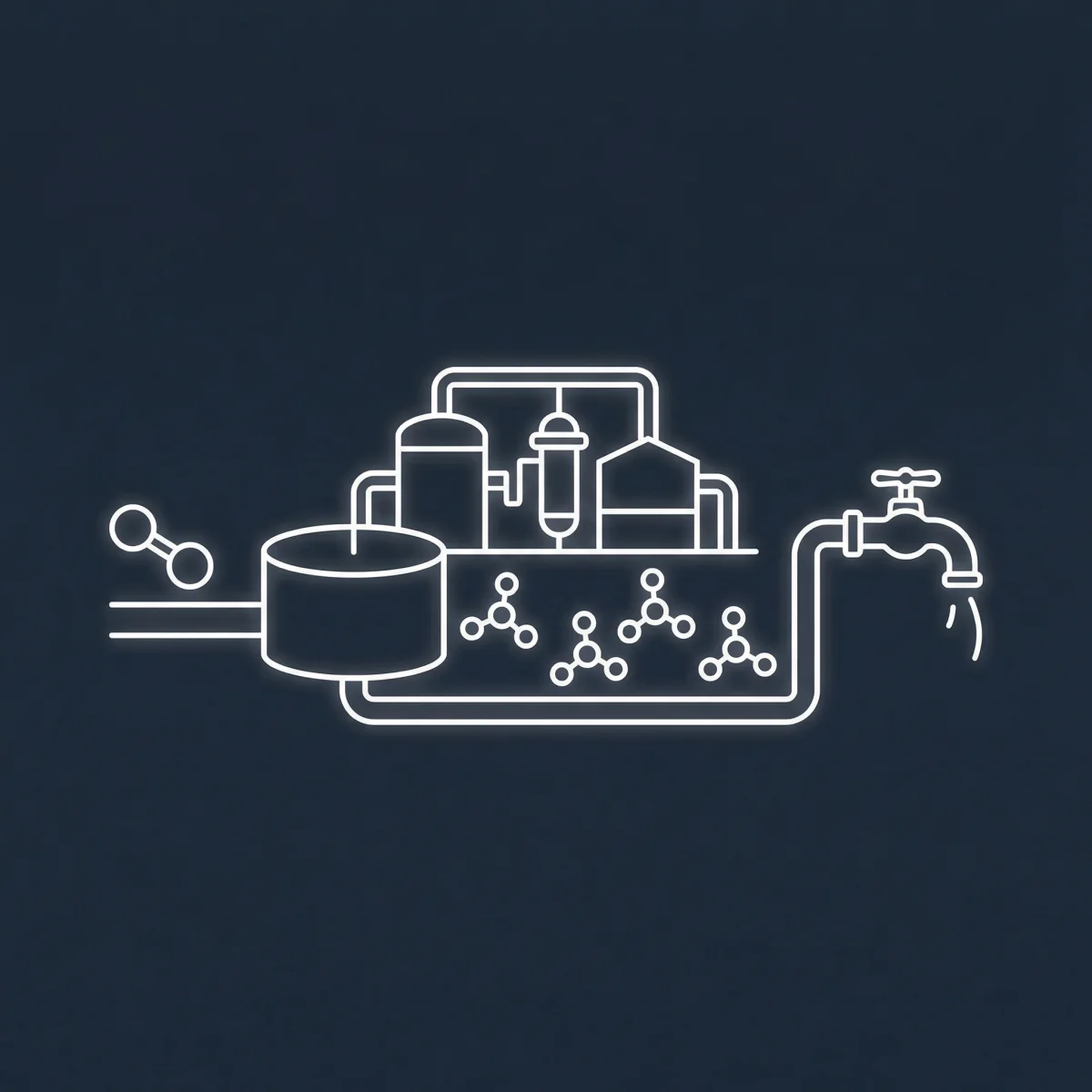
In 1908, Jersey City, New Jersey became the first city in the United States to continuously chlorinate its municipal water supply. Within a decade, typhoid fever rates in American cities had dropped by more than 50%. Chlorination is, without exaggeration, one of the most consequential public health interventions in human history.
It is also producing a set of chemical byproducts that have been associated, in epidemiological studies, with bladder cancer and adverse pregnancy outcomes.
None of that is an argument for turning off the chlorine. The alternative, waterborne typhoid and cholera and dysentery, is far worse. It is an argument for understanding what's in your municipal water and what you can do about it.
How Disinfection Byproducts Form
Chlorine doesn't only kill bacteria. It also reacts with the organic matter naturally floating in water (decomposed plant material, algae, sediment) and forms a family of compounds called disinfection byproducts, or DBPs.
There are two main categories. Trihalomethanes, or THMs, of which chloroform is the most common. And haloacetic acids, or HAAs. Both are regulated by the EPA under the National Primary Drinking Water Regulations. The maximum contaminant level for total THMs is 80 parts per billion. For HAAs it's 60 ppb.
How many DBPs form comes down to two things: how much chlorine goes in, and how much organic matter the source water carries. Surface water (rivers and reservoirs) holds more organic matter than groundwater. Connecticut's major municipal systems draw mostly from surface water. The MDC system pulls from the Barkhamsted and Nepaug reservoirs. The South Central Connecticut Regional Water Authority pulls from Lake Whitney and Lake Gaillard. Aquarion uses a mix of surface and groundwater sources.
How Dangerous Are Disinfection Byproducts?
The epidemiological evidence on DBPs and health effects has been accumulating for decades. A 2010 meta-analysis in Epidemiology found that long-term consumption of chlorinated drinking water was associated with a 35% increased risk of bladder cancer. A 2004 study in the American Journal of Epidemiology found associations between THM exposure and adverse pregnancy outcomes, including low birth weight and preterm birth.
These are associations, not proven causation. But the findings keep repeating across different studies and different populations, which is why the EPA set and enforces DBP limits, and why the International Agency for Research on Cancer classifies chloroform (a THM) as a possible human carcinogen. The pregnancy data is the part that worries people most. If you or someone in your household is pregnant, our guide on water quality risks during pregnancy in Connecticut covers what to watch for.
The EPA's limits, 80 ppb for THMs and 60 ppb for HAAs, are meant to hold risk to an acceptable level while keeping disinfection effective. They are not zero-risk thresholds. The EWG's Tap Water Database sets much stricter health guidelines for THMs and HAAs, based on more recent cancer research.
What Can Connecticut Residents Do to Reduce DBP Exposure?
The most effective way to reduce DBP exposure from municipal water is activated carbon filtration. Granular activated carbon (GAC) and solid block carbon filters both effectively reduce THMs and HAAs. A standard under-sink carbon filter or a pitcher filter with a carbon block will significantly reduce DBP levels in your drinking water.
For DBPs, look for filters certified to NSF/ANSI Standard 53 for VOC reduction. Most decent carbon filters meet it.
There's a small irony here. The same filter that cuts DBPs also cuts the chlorine taste and smell, which is the thing people actually complain about. The health fix and the taste fix are the same purchase. If you're weighing options, our guide to what reverse osmosis removes explains how RO compares to carbon filtration across different contaminants.
Want ZIP-level context before deciding whether to test? Enter your ZIP code at CheckYourTap.com to see available public-system or regional monitoring records associated with the ZIP. This is not a test of a tap, well, or property. Free, in 30 seconds.
Keep Reading
- You're Pregnant in Connecticut. Here's What to Know About Your Water Before Your Next Glass.
- Reverse Osmosis Removes Almost Everything. Here's What Connecticut Homeowners Need to Know Before Buying One.
- The Connection Between Your Water, Your Thyroid, and Your Hair That Nobody Is Making
Sources: Epidemiology, DBP and bladder cancer meta-analysis, 2010; American Journal of Epidemiology, THM and pregnancy outcomes, 2004; EPA Disinfection Byproducts Rule; IARC Monographs on Chloroform; CT DPH Water Quality Reports.
