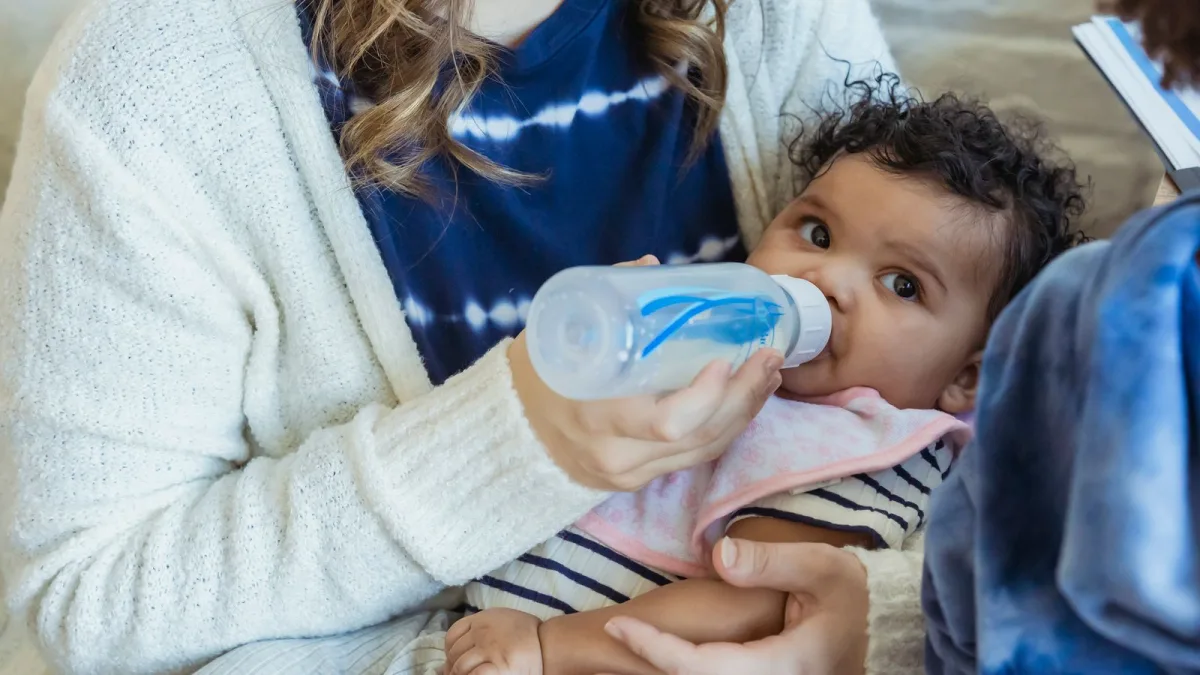
Cadmium that fully meets the EPA's legal limit can still carry far more of the metal than an infant is safely protected against. The federal maximum for cadmium in drinking water is 5 ppb, but the health-protective guideline is 0.04 ppb (the Environmental Working Group's health guideline; the California OEHHA public health goal is 0.07 ppb). That legal limit sits 125 times above the health number. It was built around adult body weight and what treatment plants can feasibly achieve, not around a newborn drinking formula. The practical fix is a reverse-osmosis or certified filter for the water you mix formula with.
Cadmium gets less attention than lead or arsenic, but for a household with a baby it deserves the same seriousness. It is tasteless, odorless, and invisible, and it does not break down in the environment. What makes it different from most contaminants is what happens after it is swallowed: cadmium is stored, not cleared. Its biological half-life is 17 to 38 years (ATSDR Toxicological Profile for Cadmium), so exposure that starts at birth compounds for a lifetime.
This is the gap that a compliance report does not cover. Your utility can truthfully say the water meets every federal standard while that same water sits well above the level that protects a developing kidney. Below is what "safe" actually means for an infant, and why the biology tilts against the youngest drinkers.
Legal Limit vs. Health Guideline for Cadmium
The EPA's legal limit for cadmium is 5 ppb, while the health-protective guideline is 0.04 ppb (EWG), a 125-fold difference. Regulatory limits weigh treatment cost and feasibility alongside health; health guidelines from EWG and OEHHA reflect the concentration tied to negligible long-term risk. For an infant, the health number is the one that matters.
| Contaminant | EPA Legal Limit (MCL) | EWG Health Guideline | CheckYourTap Safe Level (Infants) |
|---|---|---|---|
| Cadmium | 5 ppb (0.005 mg/L) | 0.04 ppb | 0.04 ppb (EWG; OEHHA PHG 0.07 ppb) |
The "CheckYourTap Safe Level (Infants)" cell is the EWG general-population health guideline, the most protective published number, not an infant-specific derived value.
The published safe level is the health-protective figure, not the legal one. We also model an infant-specific, intake-adjusted estimate that accounts for a newborn's high water intake and higher absorption; that internal estimate lands in the low tenths of a ppb, still far below the 5 ppb legal limit, but the EWG health guideline of 0.04 ppb remains the most protective number we publish. Either way, the conclusion is the same: legal is not the same as safe.
One honest note on the math. The 125x figure is simply the legal limit divided by the published health guideline (5 ÷ 0.04). It is not a claim that 5 ppb water is "125 times more toxic," but a measure of how much headroom the law leaves above the health target.
Why Do Infants Accumulate More Cadmium Than Adults?
Infants accumulate more cadmium for two compounding reasons: they take in more relative to their size, and their bodies absorb a larger share of it. A newborn drinks roughly 146 mL of water per kilogram of body weight each day in the first month of life, largely through reconstituted formula, a fluid-to-weight ratio several times higher than an adult's. Mix that water with a contaminant the body cannot excrete, and the dose per pound climbs fast.
Absorption is the second lever, and it is the one people underestimate. An adult absorbs only a small fraction of ingested cadmium, on the order of a few percent. An infant's gut absorbs considerably more. Part of the reason is that a growing baby is primed to pull calcium and iron from food, and cadmium hitches a ride on those same mineral transport pathways. The toxicology literature describes infant and child gastrointestinal uptake of metals running well above adult rates (Chandravanshi et al., 2021).
Then the half-life does the rest. Because cadmium's biological half-life is 17 to 38 years (ATSDR) and the body has no efficient route to excrete it, whatever is absorbed largely stays. Start that clock at birth instead of in adulthood and the peak lifetime body burden is higher. Prevention early is the only lever that actually changes the trajectory.
What Does Cadmium Do to the Kidneys and Bones?
Cadmium's primary targets are the kidney and bone, and the damage accrues quietly over years. Absorbed cadmium binds to a protein called metallothionein and is carried to the kidney, where it concentrates in the renal cortex. Over time it injures the proximal tubules, the structures that reabsorb nutrients and protein from filtered blood. Early damage often shows up as low-molecular-weight proteins spilling into the urine.
Once the proximal tubule is compromised, the loss tends to be permanent, and continued exposure raises the long-run risk of chronic kidney dysfunction (Satarug et al., 2000). For a child, the concern is not an acute illness this month; it is decades of a rising burden on an organ that had a head start on accumulation. Bone is the second target: cadmium interferes with calcium handling and, over long exposures in adults, is linked to reduced bone density.
Cadmium is also classified as a known human carcinogen by the International Agency for Research on Cancer, and it acts as an endocrine disruptor. None of these effects are reasons to panic over a single glass of water. They are reasons to keep an infant's cumulative, lifelong intake as low as reasonably possible, starting with the water that goes into the bottle.
Where Does Cadmium in Tap Water Come From?
Most cadmium in tap water traces back to two sources: aging plumbing and industrial or agricultural runoff. Cadmium is a common impurity in the zinc used to galvanize steel pipe, so as older galvanized pipes corrode, cadmium can leach directly into household water. Homes built before the 1960s carry the highest plumbing-related risk. Because this happens inside your own walls, a clean utility report does not rule it out.
The other pathway is the source water itself. Cadmium enters groundwater and surface water through industrial discharge and through phosphate fertilizers applied to farmland, which is why private wells near industrial sites or heavy agricultural areas deserve annual heavy-metal testing. Cadmium is tasteless, odorless, and colorless, so there is no sensory clue. The only way to know your concentration is a laboratory test of the water at your tap.
A word of caution that surprises people: do not boil water to make it safer against cadmium. Boiling kills microbes, but it evaporates water and concentrates heavy metals like cadmium rather than removing them.
How Do You Remove Cadmium From Drinking Water?
Reverse osmosis is the most reliable way to remove cadmium, cutting up to about 99% and driving levels well below the 0.04 ppb health guideline. Standard carbon pitcher and refrigerator filters are generally not built for heavy metals and should not be relied on here. For formula water, choose a technology proven for heavy-metal reduction and verify the certification.
- Reverse osmosis (RO): Forces water through a semi-permeable membrane that blocks heavy metals, removing up to ~99% of cadmium. An under-sink RO system is the most practical on-demand option for daily formula preparation. Because RO also strips beneficial minerals, that is a non-issue for formula, which already contains a balanced mineral profile.
- Distillation: Boils water to steam and condenses it, leaving cadmium behind. Nearly as effective as RO but slow and energy-hungry, so it fits low-volume needs better than a busy formula schedule.
- Ion exchange: Resin swaps harmless ions for heavy-metal ions. Choose a unit explicitly certified to NSF/ANSI Standard 53 for heavy-metal reduction so you know it was independently tested for the contaminant you care about.
Why We Set a Separate Number for Infants
Most water-safety resources publish one threshold per contaminant and hand it to everyone, from a 200-pound adult to a six-pound newborn. We don't. For cadmium specifically, the biology refuses to be flattened: a newborn drinks several times more water per pound, absorbs a larger fraction of it, and then holds onto it for decades thanks to a 10-to-30-year half-life. A level that barely registers for a healthy adult can quietly load a baby's kidneys. So we set the safe level by population group: newborns, infants, pregnancy, older adults, even dogs and cats. Each threshold is anchored to what protects a body rather than what a treatment plant can afford. Building thresholds that way is slower than repeating one number, and we would rather get the science right. Reports are personalized for Connecticut today, and we are expanding to more states.
Protecting an infant's kidneys means looking past "meets federal standards." The compliance report answers a legal question. The 0.04 ppb health guideline answers the one that matters for your baby, and a filter at the tap is what closes the distance between them.
This article is for general information and is not medical advice. Talk to your pediatrician about your specific water source and any health concerns for your child.
Keep Reading
- Is Tap Water Safe During Pregnancy? The Gap Between Legal and Safe
- Arsenic in Well Water While Pregnant: What "Safe" Really Means
- Reverse Osmosis: What It Actually Removes From Your Water
- Cadmium: contaminant overview and safe levels
Sources: EPA National Primary Drinking Water Regulations (cadmium MCL, 5 ppb); EWG Tap Water Database (cadmium health guideline, 0.04 ppb); California OEHHA Public Health Goals (cadmium PHG, 0.07 ppb, 2006); ATSDR Toxicological Profile for Cadmium (biological half-life and kidney/bone toxicity); Chandravanshi L, et al., "Developmental toxicity of cadmium in infants and children: a review," Environmental Analysis Health and Toxicology (2021); Satarug S, et al., "Safe levels of cadmium intake to prevent renal toxicity in human subjects," British Journal of Nutrition (2000); International Agency for Research on Cancer, cadmium carcinogen classification.
