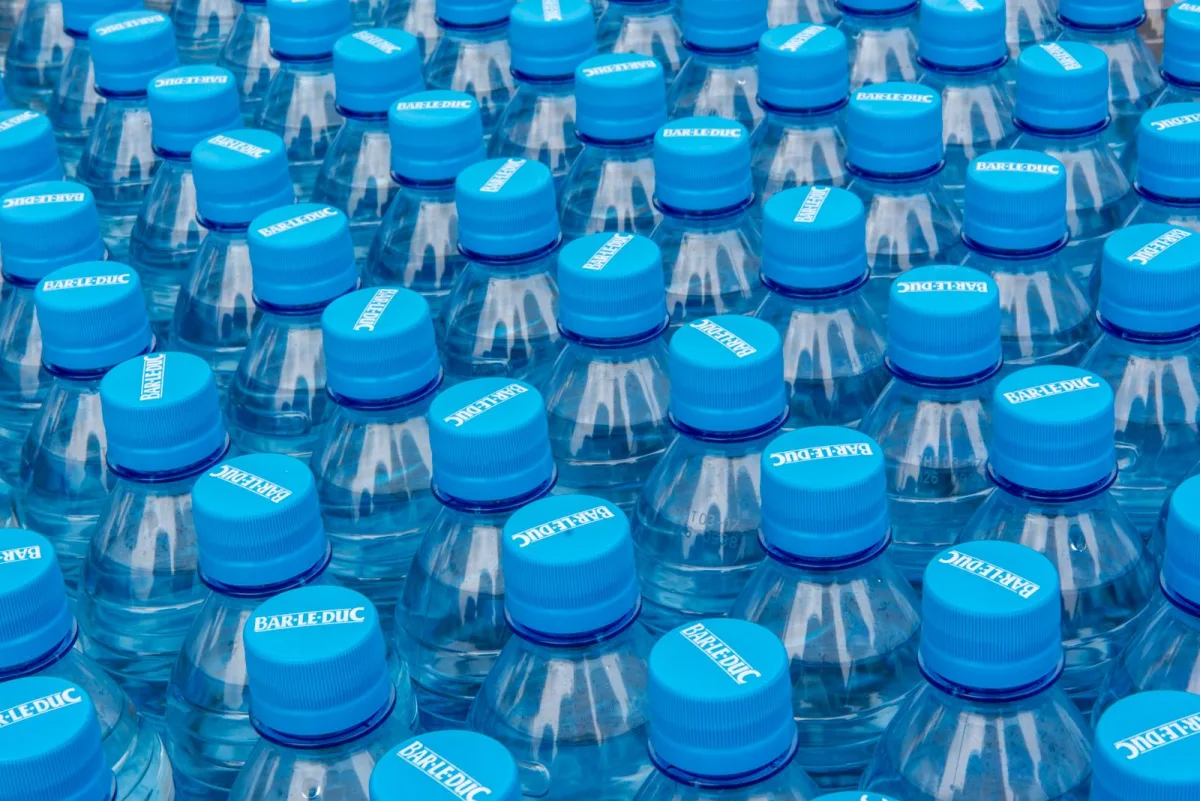
Bottled water is not automatically safer than tap water during pregnancy, and the microplastic data points the other way. A 2018 analysis in Frontiers in Chemistry found bottled water averaged 325 microplastic particles per liter, and people who drink only bottled water ingest an estimated 90,000 microplastic particles a year versus about 4,000 for tap, because particles shed from the plastic bottle itself. There is no health-based safe level for microplastics yet, so the reliable move is filtering tap water, not reaching for a plastic bottle.
Here's the assumption worth questioning. Many people switch to bottled water in pregnancy because it feels purer and better controlled than what comes from the municipal system. Tap water has real issues: aging pipes, lead, agricultural runoff. But bottled water adds a problem that tap water mostly does not, and it comes baked into the packaging. Every bottle is a plastic container in contact with the water for weeks or months, through heat, light, and handling.
This post compares bottled versus tap on microplastics specifically, explains why no agency has published a safe number, and covers what actually removes these particles. It's national guidance, not tied to any one state.
Legal Limits vs. Health Guidelines for Microplastics
Microplastics sit in an unusual regulatory spot: there is no legal limit and no health-based safe value to compare it against. The EPA sets no federal maximum contaminant level for microplastics under the National Primary Drinking Water Regulations, and the Environmental Working Group publishes no numeric health guideline either. The table below is honest about that gap.
| Contaminant | EPA Legal Limit (MCL) | EWG Health Guideline | CheckYourTap Safe Level (Pregnancy) |
|---|---|---|---|
| Microplastics | None (no federal MCL) | None established | No health-based level established yet |
We won't fabricate a threshold to fill that last cell. The science hasn't produced a defensible number for what a developing baby is safely protected against, and inventing one would be worse than admitting the gap. What we can say with confidence is directional: less plastic in contact with the water means less microplastic in the water. That single fact is what makes the bottled-versus-tap comparison matter.
Citation capsule: There is no federal maximum contaminant level for microplastics in U.S. drinking water, and no authority has published a numeric health-based safe level. The World Health Organization's 2019 review concluded the available evidence was limited and called for more research rather than setting a guideline value (WHO, Microplastics in drinking-water, 2019).
Does Bottled Water Really Have More Microplastics Than Tap?
Yes, the leading studies point that way. A 2018 study of 259 bottles across 11 brands and nine countries found microplastic in 93% of bottles, averaging 325 particles per liter across all particle sizes (Mason et al., Frontiers in Chemistry, 2018). Most of that total came from fragments smaller than 100 micrometers. Among the larger particles that older tap water methods could also count, bottled ran roughly twice as high, about 10.4 versus 5.45 particles per liter. A 2024 study using advanced imaging pushed the count far higher for nanoplastics.
That 2024 work, published in the Proceedings of the National Academy of Sciences, detected an average near 240,000 plastic fragments per liter in bottled water, with about 90% being nanoplastics smaller than one micrometer (Qian et al., PNAS, 2024). Older methods simply couldn't see particles that small, which is why counts keep climbing as instruments improve. The particles come from the bottle and cap grinding against the water, and heat during shipping and storage accelerates the shedding.
The exposure difference adds up over time. A widely cited 2019 analysis estimated that people who drink only bottled water ingest roughly 90,000 microplastic particles a year, compared with about 4,000 for those who drink only tap water (Cox et al., Environmental Science and Technology, 2019). Across the roughly nine months of a pregnancy, that gap represents a large, avoidable difference in particle intake, driven almost entirely by the packaging choice rather than the source water. The per-liter concentration gap is smaller than this annual-intake gap because the yearly estimate counts all particle sizes and assumes a person drinks bottled water exclusively.
Citation capsule: Bottled water contained microplastic in 93% of bottles tested, averaging 325 particles per liter across all particle sizes; among particles larger than 100 micrometers, bottled ran roughly twice as high as tap, about 10.4 versus 5.45 per liter (Mason et al., Frontiers in Chemistry, 2018). People drinking only bottled water are estimated to ingest about 90,000 microplastic particles yearly versus 4,000 for tap-only drinkers (Cox et al., 2019).
Why Are There No "Safe" Microplastic Numbers Yet?
The honest answer is that the science is still young. Regulators have not set a health-based limit because researchers cannot yet say how many particles, of which sizes and polymers, produce which effects in humans. California is the only jurisdiction to formally define "microplastics in drinking water" and require standardized testing, and even that framework stops short of a health limit (California State Water Resources Control Board, 2020).
Researchers have begun building health-based screening frameworks to fill the gap. Work by Coffin and colleagues in 2022 proposed provisional screening levels for California drinking water, but the authors were explicit that these are preliminary tools for prioritizing action, not validated safety thresholds (Coffin et al., Microplastics and Nanoplastics, 2022). The WHO reached a similar conclusion: not enough data to set a number, and an urgent need for better exposure and toxicity research.
Here's the practical takeaway that follows from all this uncertainty. When there's no safe threshold to aim for, "as low as reasonably achievable" becomes the sensible goal, especially in pregnancy. That reframes the whole bottled-versus-tap question. You can't chase a target number that doesn't exist, but you can cut the largest controllable source, which for most people is single-use plastic bottles.
Can Microplastics Reach the Baby During Pregnancy?
Emerging evidence says the smallest particles can cross biological barriers. A 2021 study reported the first detection of microplastics in human placenta tissue, finding particles on both the maternal and fetal sides (Ragusa et al., Environment International, 2021). The particles were small enough, generally under 10 micrometers, to be carried across the placental interface.
The concern isn't the plastic alone. Plastics carry and leach chemical additives, including bisphenols and phthalates, which are studied as endocrine disruptors that can interfere with hormone signaling during development. Nanoplastics also raise the possibility of localized inflammation and oxidative stress in sensitive tissue. None of this has produced a settled dose-response picture in humans, and we won't overstate it. The mechanism is plausible and actively researched, not proven at any specific water concentration.
That uncertainty cuts toward caution, not complacency. During pregnancy, the sensible response to "we can't yet quantify the risk, but particles do reach the placenta" is to reduce the exposure you control. Bottled water is the easiest lever to pull.
What Removes Microplastics From Tap Water?
Filtration closes most of the gap, and the right filter matters. Standard pitcher filters and ion-exchange softeners are not designed for physical particle removal, so leaning on them alone leaves microplastics largely in place. Two technologies do the real work.
Reverse osmosis (the most complete option)
Reverse osmosis forces water through a semi-permeable membrane with pore sizes near 0.0001 microns. Because even nanoplastics are generally larger than that, an RO system blocks the vast majority of plastic fragments, along with lead, arsenic, nitrate, and PFAS. An under-sink RO unit gives you filtered water for drinking and cooking without any plastic bottle in the chain. RO also strips beneficial minerals, so keep calcium and magnesium up through diet or prenatal vitamins.
Certified carbon block (a strong second)
If RO isn't feasible, a solid carbon block filter certified to NSF/ANSI Standard 53 for Class I particulate reduction (0.5 to 1 micron) traps particles down to roughly 0.5 microns. Look specifically for that Standard 53 particulate claim: NSF/ANSI 401 certifies removal of dissolved emerging compounds like pharmaceuticals, not physical particulates. A Standard 53 carbon block won't catch the smallest nanoplastics as reliably as RO, but it sharply reduces microplastic load and, just as importantly, eliminates the packaging that sheds plastic in the first place.
One reminder that surprises people: don't boil water to remove microplastics. Boiling can help some particles settle out in hard water, but it doesn't reliably eliminate them, and for dissolved contaminants like arsenic it actually concentrates them. Filtration is the dependable route.
Why we don't publish a fake microplastic number
Most water resources either ignore microplastics or invent a tidy threshold to look authoritative. We do neither. CheckYourTap sets health-protective levels per group, pregnancy, newborns, older adults, even dogs and cats, and for microplastics that means saying plainly that the science hasn't yet produced a defensible safe number for any of them. We'd rather flag "no established limit, reduce exposure" than manufacture false precision. Building the database contaminant by contaminant and group by group is the slower, more honest path, and it's why we leave this cell blank instead of guessing. The live personalized report covers Connecticut today, and we're expanding state by state.
The Bottom Line for Pregnancy
Switching to bottled water for a safer pregnancy is a reasonable instinct that the data doesn't support. Bottled water repeatedly measures higher in microplastics than tap, the packaging is the source, and no safe number exists to reassure you either way. The stronger move is to keep drinking tap water and filter it: an NSF/ANSI 58 reverse-osmosis system for the water you drink and cook with removes microplastics along with lead, arsenic, and PFAS. That closes the largest controllable exposure while you wait for the science to catch up.
This article is for general information and is not medical advice. Talk to your prenatal provider about your specific water source and any health concerns.
Keep Reading
- Is Tap Water Safe During Pregnancy? The Gap Between Legal and Safe
- Arsenic in Well Water While Pregnant: Why 10 ppb Is 2,500x Too High
- Microplastics and Reproductive Health: The Emerging Research
- Microplastics in Drinking Water: What to Know
Sources: EPA National Primary Drinking Water Regulations (no federal MCL for microplastics); EWG Tap Water Database (health guidelines); Mason, Welch, and Neratko, Frontiers in Chemistry, 2018 (bottled water averaged 325 particles per liter, 93% of bottles contaminated); Qian et al., Proceedings of the National Academy of Sciences, 2024 (~240,000 fragments per liter, 90% nanoplastics); Cox et al., Environmental Science and Technology, 2019 (~90,000 particles/year bottled vs ~4,000 tap); Ragusa et al., Environment International, 2021 (microplastics in human placenta); Coffin et al., Microplastics and Nanoplastics, 2022 (provisional screening framework); World Health Organization, Microplastics in drinking-water, 2019 (evidence limited, no guideline set); California State Water Resources Control Board, 2020 (definition and testing framework).
