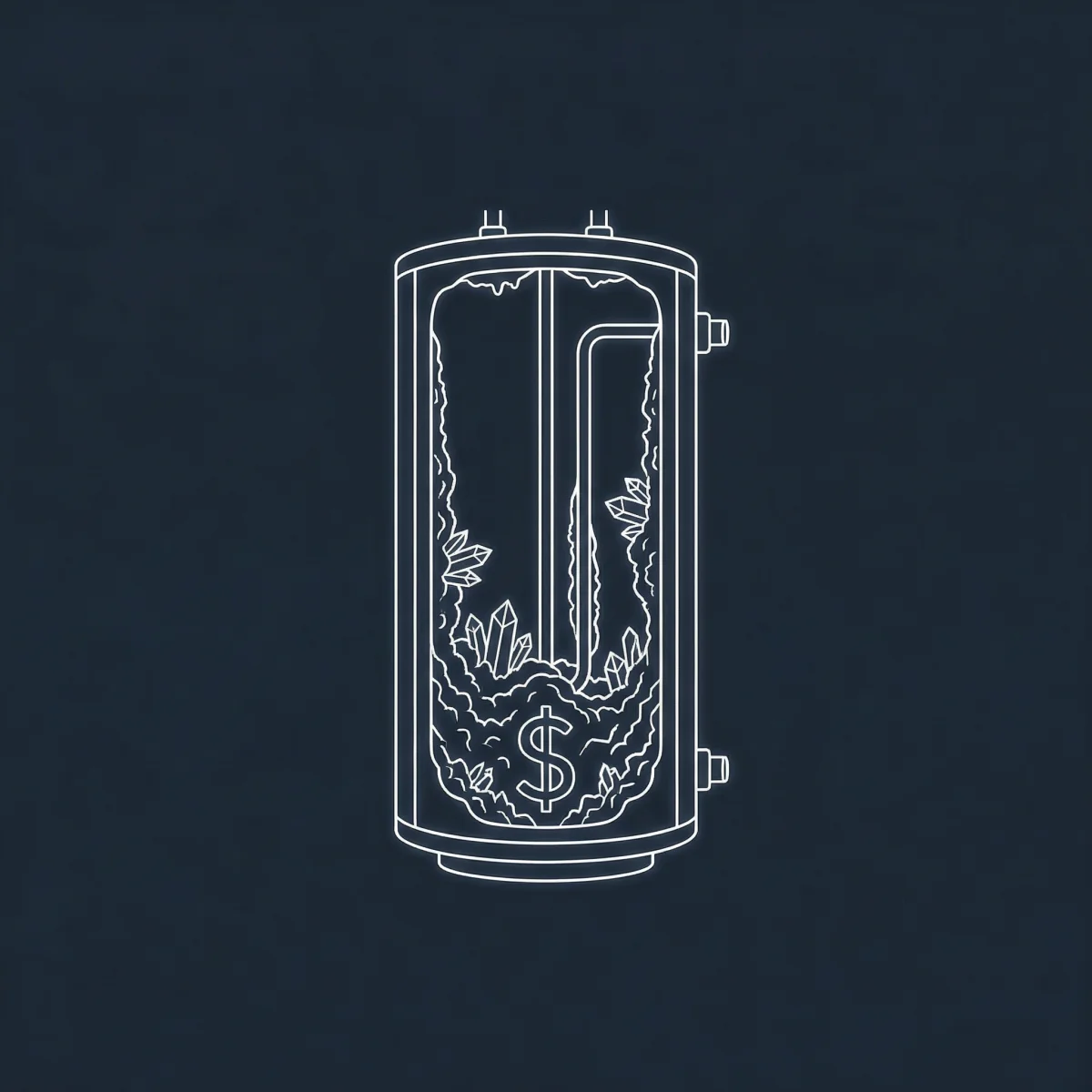
Most Connecticut homeowners think about their water heater twice: when they buy the house, and when it fails. The water heater sits in the basement, does its job, and gets ignored until it doesn't.
If you're in a hard water area, and most of Fairfield County qualifies, scale has been building inside that tank since the day it was installed. What that actually costs you depends on one thing almost nobody mentions: whether you heat with gas or electricity.
How Does Scale Actually Form Inside Your Water Heater?
When hard water is heated, the calcium and magnesium dissolved in it precipitate out as calcium carbonate, the same material as limestone. It deposits on whatever it touches: the heating element in an electric heater, the heat exchanger in a gas heater, the walls of the tank.
Scale is a good insulator, which is the whole problem. Where heat has to travel through a scaled surface to reach the water, the burner works harder. Where the heat source sits in the water, it mostly doesn't. That distinction is the difference between gas and electric, and it turns out to matter more than the hardness number itself.
This has been measured. In the Softened Water Benefit Study, run by Battelle Memorial Institute for the Water Quality Research Foundation (2009), gas storage water heaters lost about 4.3% of their life-cycle operating efficiency at 5 grains per gallon of hardness (roughly 86 ppm), and about 8.5% at 10 grains per gallon. The scale builds on the tank and the burner has to work harder to push heat through it.
In Newtown, where hardness runs at 171 ppm (about 10 grains per gallon), that puts a gas water heater around the 8.5% mark. Bridgeport at 168 ppm is essentially the same. Much of Fairfield County sits above 120 ppm, or roughly 7 grains, which falls between the study's 5- and 10-grain points, so call it somewhere around 6%. That one is our interpolation, not a measured value.
The Part Most Articles Get Wrong: Gas and Electric Are Not the Same
Here is the detail that changes the math, and almost nobody reports it. In the same Battelle study, electric storage water heaters did not lose efficiency to hard water. They started at 99.5% and ended at 99.5% on hard water (and 99.3% start to finish on softened water), because the heating elements sit submerged in the water rather than trying to push heat through a scaled tank wall.
So if you heat water with electricity, the honest answer is that scale is not quietly inflating your kilowatt-hours. What it is doing is coating the elements and the tank: Battelle measured about 2 pounds of scale a year in electric heaters on hard water, versus almost none (0.03 lb) on softened water. That shortens the life of the element and the tank. The cost is replacement, not efficiency.
If you heat water with gas, the efficiency penalty above is real and it does show up on your bill.
Where the Money Actually Goes: Replacement
The scale numbers are the ones worth paying attention to, because they are directly measured rather than modeled. On hard water, Battelle logged roughly 2 pounds of scale a year in electric storage heaters and about 1.2 pounds in gas storage heaters. On softened water, both were close to nothing (0.03 and 0.01 pounds).
That buildup is what shortens the working life of the element, the tank, and the appliances downstream. Tankless gas heaters take it worst: on hard water their efficiency fell from 80% to 72% and they had to be delimed after just 1.6 years of equivalent service. Deliming intervals track hardness directly, from about 8.4 years at 5 grains per gallon down to 4.1 years at 10 grains and 2.7 at 15.
A note on who paid for the study. The Battelle testing was funded by the Water Quality Research Foundation, which is the research arm of the water-treatment industry's trade association. We are also a company that sells a softener plan. That is a real conflict of interest on both sides, and you should weigh it. We are citing the study because it is the only controlled, instrumented test of this question we could find, and because its most useful finding cuts against the sales pitch: if you heat water with electricity, hard water is not raising your energy bill.
A new water heater in Connecticut runs $1,500 to $3,000 installed. A softener runs $800 to $2,500 installed, and a service plan is roughly $500 a year covering equipment, salt, and service.
So the honest way to decide is not to accept someone's blanket "hard water costs you $500 a year." It is to work out which of these two problems you actually have. On gas, you are paying a real efficiency penalty and buying replacements sooner. On electric, your energy use is fine; you are buying replacements sooner. Both are worth fixing at genuinely hard water, and neither is worth panicking about at 60 ppm. Start by finding out what your hardness really is.
If you're considering a softener, you may want to read about the sodium question and whether it matters for your health. And if the damage isn't limited to your water heater, our breakdown of how hard water destroys appliances across your home has the full picture.
Want ZIP-level context before deciding whether to test? Enter your ZIP code at CheckYourTap.com to see available public-system or regional monitoring records associated with the ZIP. This is not a test of a tap, well, or property. Free, in 30 seconds.
Keep Reading
- Hard Water Is Destroying Your Water Heater. Here's What It's Actually Costing You.
- Is the Salt in Your Water Softener Bad for You? The Honest Answer for Connecticut Homeowners.
- Is Your Connecticut Water Making Your Hair Fall Out? Here's What the Research Actually Says.
Sources: Battelle Memorial Institute, Softened Water Benefit Study, conducted for the Water Quality Research Foundation, 2009 (efficiency, scale-accumulation, and deliming-interval figures are from Tables ES-1 and ES-2); Connecticut hardness readings from CheckYourTap's water-quality data; installation and service pricing from Valiant Energy. Efficiency figures are for gas storage water heaters; the same study found electric storage heaters held constant efficiency on hard water.
