Most people who think about radon think about basements. They've heard the public health campaigns. They know radon comes from the soil, seeps into the lowest level of the house, and builds up if there's no ventilation. They've maybe even tested their basement. They feel like they've handled it.
What they haven't thought about is the shower.
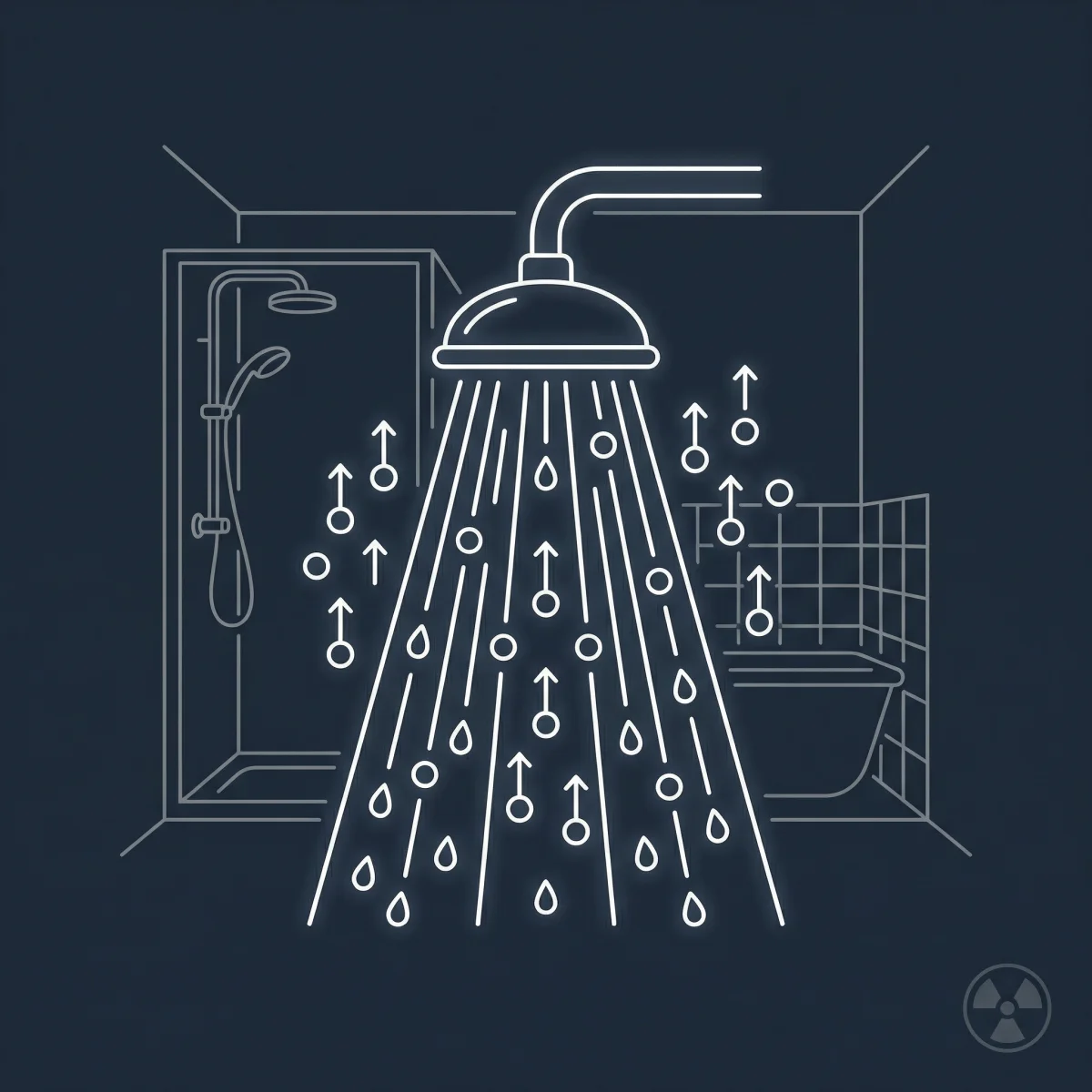
Radon in water is a separate problem from radon in soil, and it works differently. Heat or agitate water that contains dissolved radon gas, and the radon volatilizes. That happens when you run the shower, when the dishwasher runs, when you do laundry in hot water. The gas comes out of the water and into the air. Your bathroom, during and after a hot shower, can have radon concentrations significantly higher than your basement.
You're not drinking the radon. You're breathing it. Every morning.
Why Is Radon in Water Worse in Litchfield County?
Connecticut's radon risk is not uniform. The state sits on a complex geology, and radon concentrations in groundwater track closely with the underlying rock. Granite bedrock, which dominates the Litchfield Hills, the eastern highlands, and parts of the Connecticut River Valley, produces significantly more radon than the sedimentary rock beneath much of the state's coastal areas.
Litchfield County averages 5.0 pCi/L of radon in indoor air, above the EPA's action level of 4.0 pCi/L. That is an average, and individual wells in the area can run far higher, because local geology drives the number and it shifts well to well. What Connecticut gives you is a threshold to act on: CT DPH sets a recommended action level of 5,000 pCi/L for radon in well water, and recommends testing if you are on a well (CT DPH, Radon in Your Well Water).
The towns of Litchfield, Bantam, Torrington, Goshen, Sharon, Cornwall, and the surrounding communities sit on some of the most radon-productive geology in the state. If you're on a private well in this area and you've never tested your water for radon, you're making an assumption about your risk that the geology doesn't support.
How Does Radon Get from Well Water into Your Bathroom Air?
Here's the mechanism. Radon dissolves readily in cold groundwater. Your well water comes up from the aquifer carrying dissolved radon. When that water hits your hot shower, the temperature change pushes the radon out of solution, the same way CO2 comes out of a soda when you open the can. The radon becomes airborne in your bathroom.
A typical shower in radon-contaminated well water can raise bathroom air radon levels to 10-20 times the baseline level in the rest of the house. If you take a 10-minute shower in a bathroom with limited ventilation, you're breathing elevated radon for 10 minutes. Every day. For years.
The cumulative exposure adds up. Radon is the leading cause of lung cancer in non-smokers in the United States. The EPA estimates it causes about 21,000 lung cancer deaths per year. Most of those deaths are attributed to radon in air, but radon in water contributes, particularly in households whose water comes from a private well with elevated radon levels.
The Testing Gap
Here's the part that should concern every well owner in Litchfield County. Radon is not included in the standard mortgage water test. It's not included in the basic CT DPH well test. Most home inspectors don't test for it unless you specifically ask.
The result is that a significant number of households in high-radon-geology areas are using well water with elevated radon and have no idea. They tested for bacteria and nitrates. They passed. They feel safe.
Testing for radon in water is straightforward and not expensive, typically $25-$75 for the test itself. You collect the sample from a cold water tap (before any treatment), send it to a certified lab, and get results back within a week or two.
If radon is found above the EPA's suggested action level of 300 pCi/L for water, treatment options include aeration systems (which bubble the radon out of the water before it enters the house) and granular activated carbon filters. Aeration is generally preferred for high radon levels because it doesn't accumulate radioactive decay products the way carbon filters can.
The Practical Reality
If you live in Litchfield County, Tolland County, or eastern Connecticut on a private well, and you've never tested your water for radon, add it to the next test. It's a small addition to a comprehensive water test, and the result tells you something important about what you're breathing every morning. The same granite bedrock that produces radon also produces uranium in some eastern Connecticut wells, another contaminant the standard test misses.
Want ZIP-level context before deciding whether to test? Enter your ZIP code at CheckYourTap.com to see available public-system or regional monitoring records associated with the ZIP. This is not a test of a tap, well, or property. Free, in 30 seconds.
The basement test you did three years ago doesn't tell you about the water. They're separate pathways. You need to test both.
And if you do find elevated radon in your water, the fix is real and it works. An aeration system installed at the point of entry, where the water comes into the house, removes the radon before it ever reaches your taps. The shower stops being a problem. The dishwasher stops being a problem. The water is clean.
Keep Reading
- The Water Test You Got When You Bought Your House Is Worthless Now
- There's Uranium in Some Eastern Connecticut Wells. It's Not from a Nuclear Plant.
- You're Pregnant in Connecticut. Here's What to Know About Your Water Before Your Next Glass.
Sources: CT DPH Radon in Your Well Water guidance; CTCASE Radon in Connecticut's Drinking Water Supplies study; EPA, Health Risk of Radon; Litchfield radon data, RadonResources.com; CT DPH radon potential map.
