If you live in Fairfield County, you've probably noticed that thyroid disease is common. It comes up at dinner parties, in pediatricians' offices, in conversations between women in their thirties and forties who are trying to figure out why they're exhausted, why they're gaining weight, why their hair is thinning.
The standard explanation is that thyroid disease is common everywhere — it affects an estimated 20 million Americans — and that Fairfield County's high rates of diagnosis reflect better access to healthcare and more frequent testing, not necessarily higher actual prevalence.
That explanation may be partially right. It is probably not the complete story.
How Does PFAS Affect the Thyroid?
PFAS compounds are endocrine disruptors. This is not a contested claim — it is established in the peer-reviewed literature. The mechanism is relatively well-understood: PFAS compounds, particularly PFOA and PFOS, interfere with thyroid hormone binding proteins, reducing the availability of thyroid hormones in the bloodstream. They also appear to affect the thyroid gland's ability to produce hormones in the first place.
A 2010 study in Environmental Health Perspectives, using data from the National Health and Nutrition Examination Survey, found that higher serum PFOA levels were associated with thyroid disease in women and older adults. A 2013 study in the same journal found associations between PFAS exposure and altered thyroid hormone levels in pregnant women — a finding with implications not just for the mothers but for fetal brain development.
A 2020 meta-analysis in Environmental Research reviewed 23 studies on PFAS and thyroid function and concluded that the evidence for an association was "consistent and robust."
Can Thyroid Problems from PFAS Cause Hair Loss?
Thyroid dysfunction — particularly hypothyroidism, where the thyroid produces insufficient hormone — is one of the most common causes of diffuse hair loss in adults, as the American Thyroid Association has documented. The mechanism is direct: thyroid hormones regulate the hair growth cycle. When thyroid hormone levels are insufficient, hair follicles spend more time in the resting (telogen) phase and less time in the growth (anagen) phase. The result is diffuse thinning across the scalp.
This is not subtle hair loss. It's the kind of hair loss that prompts people to see a dermatologist, who orders a thyroid panel, who finds subclinical hypothyroidism, who prescribes levothyroxine. The hair loss improves. The patient is grateful. Nobody asks what caused the thyroid dysfunction.
The Fairfield County Situation
Aquarion Water Company, which serves most of Fairfield County, has a documented PFAS problem in its groundwater-dependent supply sources. The company has committed to a roughly $150 million remediation program. The compliance deadline is 2031.
Until 2031, Fairfield County residents on Aquarion's system are drinking water that may contain PFAS above the EPA's new limits. PFAS accumulates in the body — it doesn't clear quickly. Long-term, low-level exposure is the relevant exposure scenario for most Fairfield County residents.
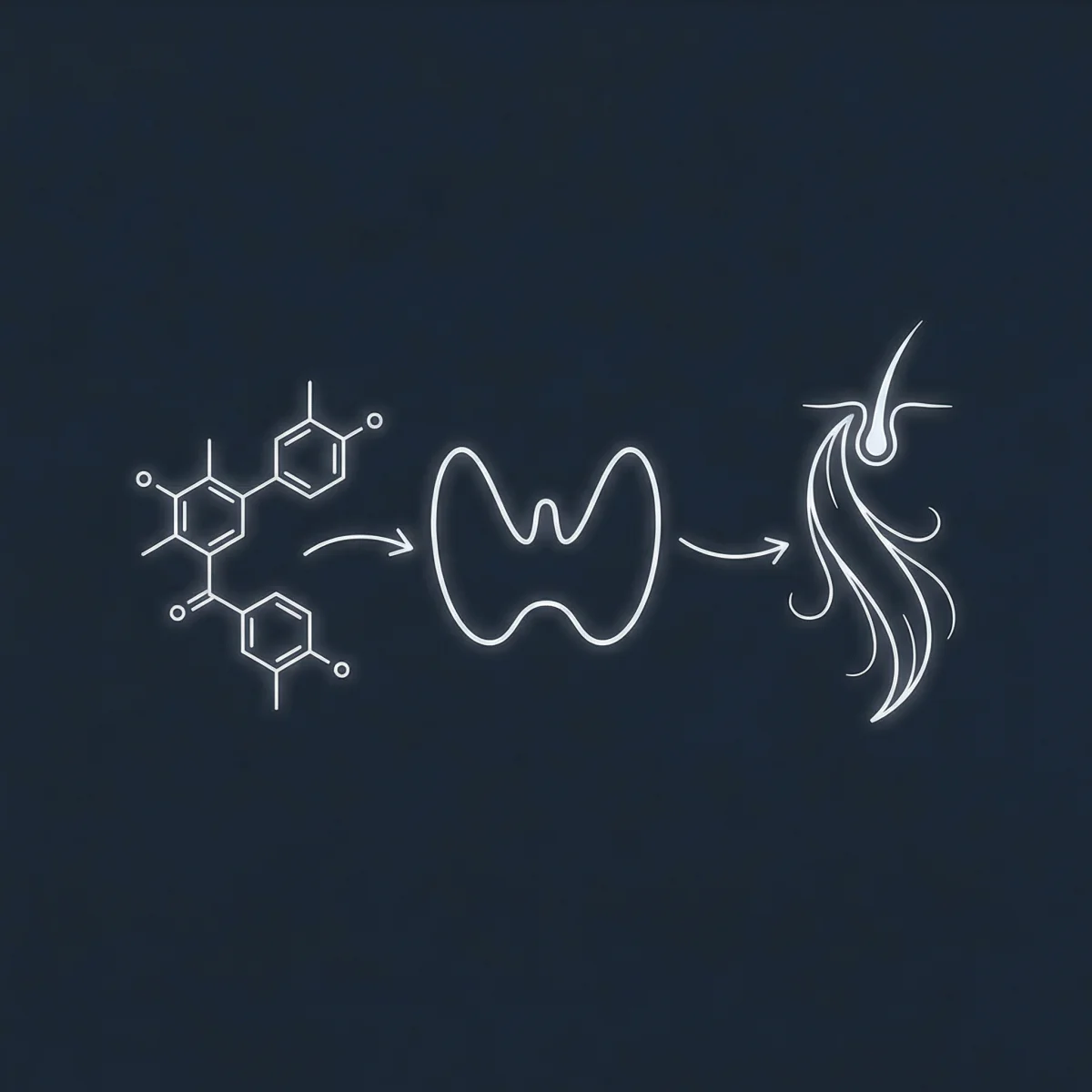
The causal chain — PFAS in Fairfield County water → PFAS accumulation in Fairfield County residents → thyroid disruption → hair loss and other thyroid symptoms — is supported by peer-reviewed research at each link. The chain as a whole is not being discussed anywhere.
What This Means Practically
Wondering if PFAS is in your drinking water? Enter your ZIP code at CheckYourTap.com to see what's in your tap water — free, in 30 seconds.
This is not a claim that PFAS in Fairfield County water is causing a thyroid epidemic. It is a claim that if you live in Fairfield County, are on Aquarion's water system, and are experiencing unexplained hair loss, fatigue, weight gain, or other thyroid symptoms, the water is a plausible contributing factor that your doctor is almost certainly not considering.
The conversation to have with your doctor is: "I'm on Aquarion's water system in Fairfield County. I know there's documented PFAS in the supply. Is it worth testing my thyroid antibodies and my serum PFAS levels?"
The answer, given the research, is yes.
The practical step is a reverse osmosis filter at your kitchen tap. RO removes PFAS effectively. It doesn't undo past exposure, but it stops the ongoing accumulation. And if you're a Connecticut Water or Aquarion customer, your water bill is already going up to pay for PFAS treatment — but the surcharge doesn't mean your water is fully treated yet.
Keep Reading
- Fairfield County Has a PFAS Problem and Your Water Bill Won't Fix It Until 2031
- Your Connecticut Water Bill Is Going Up Because of PFAS. Here's What You're Actually Paying For.
- You're Pregnant in Connecticut. Here's What to Know About Your Water Before Your Next Glass.
Frequently Asked Questions
Can PFAS in water cause thyroid disease?
A 2020 meta-analysis in Environmental Research reviewed 23 studies and concluded the evidence linking PFAS to thyroid dysfunction is "consistent and robust." PFAS compounds — particularly PFOA and PFOS — interfere with thyroid hormone binding proteins and reduce hormone availability. A 2010 study using NHANES data found higher PFOA levels were associated with thyroid disease in women and older adults. Fairfield County residents on Aquarion's water system have documented PFAS exposure through the water supply.
Does thyroid dysfunction cause hair loss?
Yes. Hypothyroidism is one of the most common causes of diffuse hair loss in adults. Thyroid hormones regulate the hair growth cycle — when levels are insufficient, hair follicles spend more time in the resting phase and less in the growth phase, causing thinning across the scalp. This is follicular hair loss (from the root), which is different from the hair breakage caused by hard water. If you're losing hair and live in a PFAS-affected area, a thyroid panel and serum PFAS test are worth requesting.
Should Fairfield County residents worry about PFAS and thyroid?
If you're on Aquarion's water system in Fairfield County and experiencing unexplained fatigue, weight gain, or hair thinning, PFAS exposure is a plausible contributing factor. The causal chain — PFAS in water to PFAS accumulation to thyroid disruption — is supported by peer-reviewed research at each link. A reverse osmosis filter at the kitchen tap ($300–$800) stops ongoing PFAS accumulation. Ask your doctor about testing thyroid antibodies and serum PFAS levels.
Sources: Environmental Health Perspectives, PFOA and thyroid disease, 2010; Environmental Health Perspectives, PFAS and thyroid in pregnancy, 2013; Environmental Research, PFAS and thyroid meta-analysis, 2020; American Thyroid Association, hypothyroidism and hair loss; Hartford Business Journal, Aquarion PFAS, March 2026.