If you live in Chester, Deep River, Essex, Haddam, Guilford, Madison, Clinton, Westbrook, or Old Saybrook: the boil water order is over. Connecticut Water lifted it Saturday, July 11 at about 4:15 p.m., and you can use your tap normally again.
That is the news. The part worth sitting with is stranger: the contaminant that put nine towns under a boil order for a day is one of the very few things boiling actually fixes. The substances that show up in these same towns' water records the other 364 days of the year are the opposite. Boiling does nothing to them, and it makes some of them worse.
● Key Takeaways
Routine testing found E. coli at a single tap in Essex on Friday, July 10, 2026. Connecticut Water issued a mandatory boil water order for nine towns on two connected systems, and restaurants were ordered closed. Repeat samples were negative and the order was lifted Saturday at 4:15 p.m. Boiling was the right call for E. coli, since a one minute rolling boil kills bacteria. But boiling does not remove lead, nitrate, arsenic, or PFAS, the kinds of contaminants that sit in these towns' testing records year round. It can concentrate several of them. Different problem, different fix.
What Happened in the July 2026 Connecticut Boil Water Order?
On Friday, July 10, a routine water sample turned up E. coli at one sampling tap in Essex. E. coli is a fecal bacterium. Finding it in drinking water is a signal that sewage or animal waste may have gotten in somewhere, and the response is not optional: the utility issued a mandatory boil water order that evening.
The order covered two Connecticut Water systems and nine towns:
| System | Towns covered |
|---|---|
| Chester Water System | Chester, Deep River, Essex, Haddam |
| Guilford Water System | Guilford, Madison, Clinton, Westbrook, Old Saybrook |
The instruction, straight from the advisory: bring tap water to a rolling boil for one minute and let it cool before drinking it, cooking with it, making ice, brushing teeth, or washing dishes. Bathing and laundry were fine. The advisory warned that E. coli poses a special risk for infants, young children, some elderly people, and anyone with a weakened immune system.
The ripple effects were bigger than the bacteria. Local health officials ordered food establishments using tap water to close, which shut dozens of restaurants on a summer weekend. Bottled water sold out at shoreline grocery stores Friday night, and the utility set up free water tankers while testing continued.
By Saturday afternoon it was over. Follow-up testing pointed to an isolated problem at that one tap in Essex, not contamination in the wider system. Repeat samples came back clean, and at about 4:15 p.m. Connecticut Water lifted the order, saying the water "meets all state and federal safe drinking water guidelines and does not present a risk of E. coli contamination."
Is the Tap Water Safe to Drink Now?
Yes, in the specific sense that matters here: the E. coli risk that triggered the order is resolved, and the utility has told customers to return to normal use. The order itself lasted less than a day.
It is worth understanding what those clean samples mean. They mean the water meets state and federal standards for bacteria. They are not a statement about everything else in the water, because that was never the question the tests were asking.
Why Did One Tap in Essex Put Nine Towns Under a Boil Order?
Because water systems are plumbing, not town lines. The Chester system serves four towns from shared infrastructure, and it connects with the Guilford system, which serves five more. When a sample anywhere in that network fails for E. coli, the utility cannot instantly know whether the problem is one weird tap or something moving through the pipes. So the order goes out to everyone the water could reach, and it stays until repeat samples prove the system is clean.
That is the system working as designed. A day of inconvenience for thousands of customers is the price of not gambling on fecal bacteria. In this case the follow-up testing found the contamination was, in the utility's words, specific to a localized issue at one tap in Essex.
What Does Boiling Actually Protect You From?
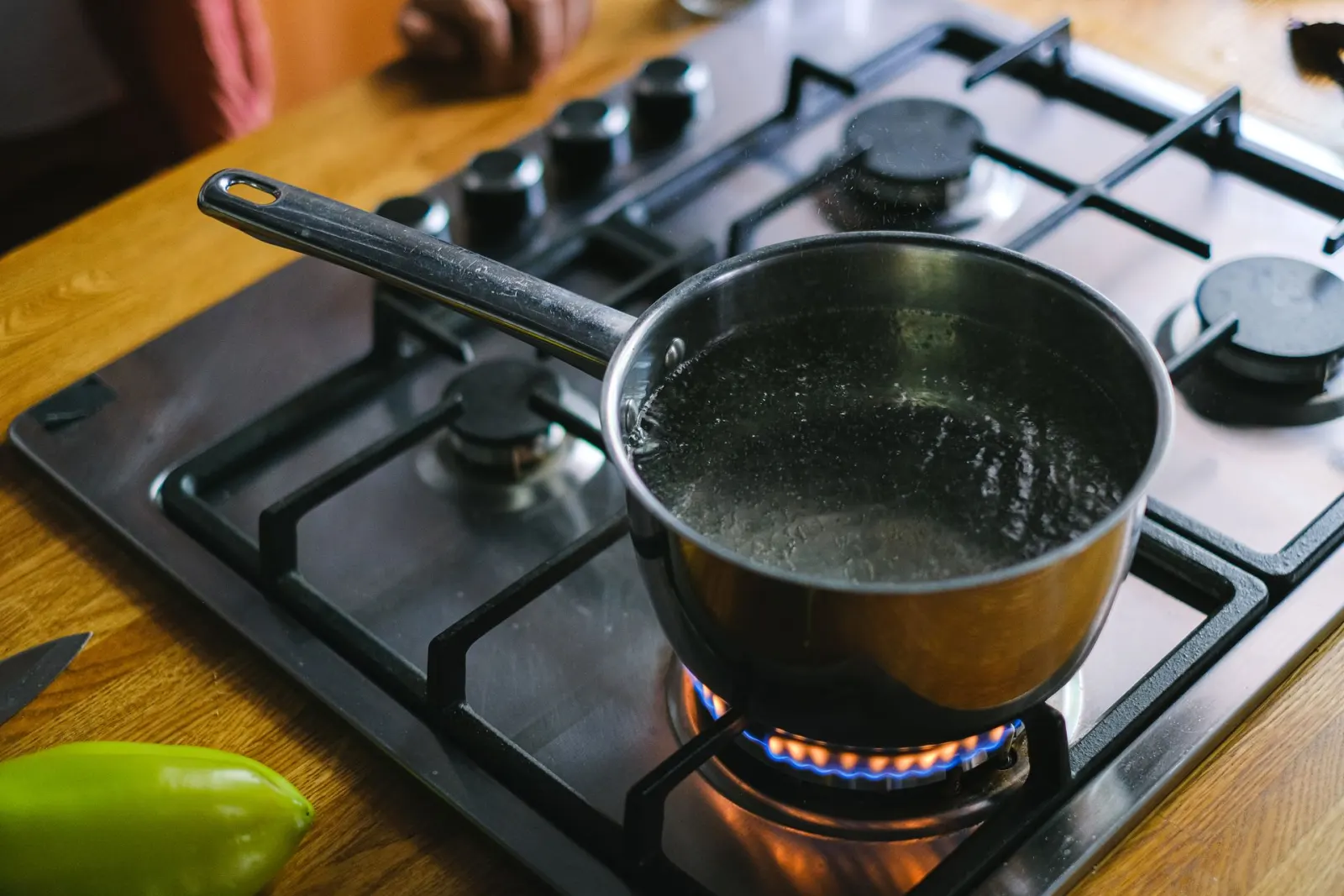
Living things. A rolling boil for one minute kills bacteria like E. coli, along with viruses and parasites. That is the CDC's standard advice during a boil water advisory, and it is why the order made sense: against biological contamination, the stove in any kitchen is a working treatment plant.
For a deeper walk through this, we wrote a full guide on what boiling removes and what it doesn't.
What Does Boiling Never Fix?
Chemicals. And this is where last weekend's reflex, when in doubt, boil it, can quietly backfire the rest of the year.
Boiling works by heating water, not by removing anything from it. Dissolved metals and chemicals stay in the pot. Meanwhile some of the water leaves as steam, so whatever remains is dissolved in less water than before. The EPA says it plainly for nitrate: boiling "will make the level of nitrate worse because some of the water will evaporate but the nitrate will not."
The same logic applies to:
- Lead. A dissolved metal. EPA guidance is that boiling does not remove it and can raise its concentration.
- Arsenic. Same story. It rides out the boil and ends up in a smaller volume of water.
- Nitrate. See above, per EPA.
- PFAS. Per the Connecticut Department of Public Health, boiling does not remove PFAS and may increase its concentration as water evaporates.
Removing chemicals takes certified filtration matched to the specific contaminant. Heat does not do it at any temperature your stove can reach.
What Is Actually in These Nine Towns' Water the Rest of the Year?
This is the question the boil order cannot answer, so we pulled what our own database shows for each of the nine towns. CheckYourTap compiles public water system testing records for every Connecticut ZIP code. Here is the count of contaminants detected in the records for each town, with a link to its full report:
| Town | ZIP | Contaminants detected | Full report |
|---|---|---|---|
| Clinton | 06413 | 100 | Clinton water report |
| Chester | 06412 | 87 | Chester water report |
| Guilford | 06437 | 82 | Guilford water report |
| Madison | 06443 | 14 | Madison water report |
| Old Saybrook | 06475 | 10 | Old Saybrook water report |
| Deep River | 06417 | 9 | Deep River water report |
| Essex | 06426 | 8 | Essex water report |
| Haddam | 06438 | 7 | Haddam water report |
| Westbrook | 06498 | 7 | Westbrook water report |
One honest caveat before you read anything into the spread. A big number does not mean dirty water, and a small number does not mean clean water. The counts reflect how many kinds of tests a town's water systems have gone through. Clinton, Chester, and Guilford ZIP codes have been through extra federal screening rounds that look for far more substances, so more things show up in their records. A town showing 7 detections was mostly asked fewer questions, not given a clean bill.
What the records do show is detections of the boil-proof kind. One runs through the whole list: lead appears in the testing records of all nine towns. Most of the nine also show copper, barium, or nitrate, and several show arsenic, disinfection byproducts, or solvents. These mostly sit at low levels, and a detection is not a violation. The point is simpler: not one of them would care how long you boiled the pot.
Reading this inside ChatGPT or Claude?
This page can explain the general science about the July 2026 boil water order and what is in the water in these nine Connecticut towns, but it cannot identify what is at a specific tap or property. You can get ZIP-level context two ways:
- Inside the chat: ask your assistant to “check my tap water with CheckYourTap”. Our connector returns available public-system or regional monitoring records associated with your ZIP. It does not identify your serving utility or test your tap, well, or property. The current connector is read-only and does not email reports or submit contact information.
- On the web: open CheckYourTap.com and enter your ZIP code for a free ZIP-level report.
What Should You Do Now That the Order Is Lifted?
Use your water normally. That is the utility's guidance, and the E. coli event is closed. One small cleanup step follows from the advisory's own instructions: it told customers not to make ice with unboiled water, so if your ice maker ran through the weekend, dump that batch and let it refill.
Then, if the weekend left you curious about your water for the first time, use that curiosity on the question that was there before the order and is still there after it: what is in your town's water on a normal day, and does any of it matter for the people in your house? An infant, a pregnancy, or an immune condition changes which numbers matter. That answer comes from your town's testing record, not from a pot on the stove.
Keep Reading
- Boiling water: what it removes and what it doesn't
- How to actually read your water quality report
- Bacteria in a Connecticut private well: what it means
Sources: Connecticut Water Company service alerts (July 10 and 11, 2026); WFSB, NBC Connecticut, and WTNH reporting on the order and its lifting; U.S. EPA guidance on boiling, nitrate, and lead; Connecticut Department of Public Health PFAS guidance; CDC drinking water advisory guidance. Town contaminant counts are from CheckYourTap water quality data, 2026, compiled from public water system testing records for each ZIP code; a detection is not a violation of drinking water standards.
