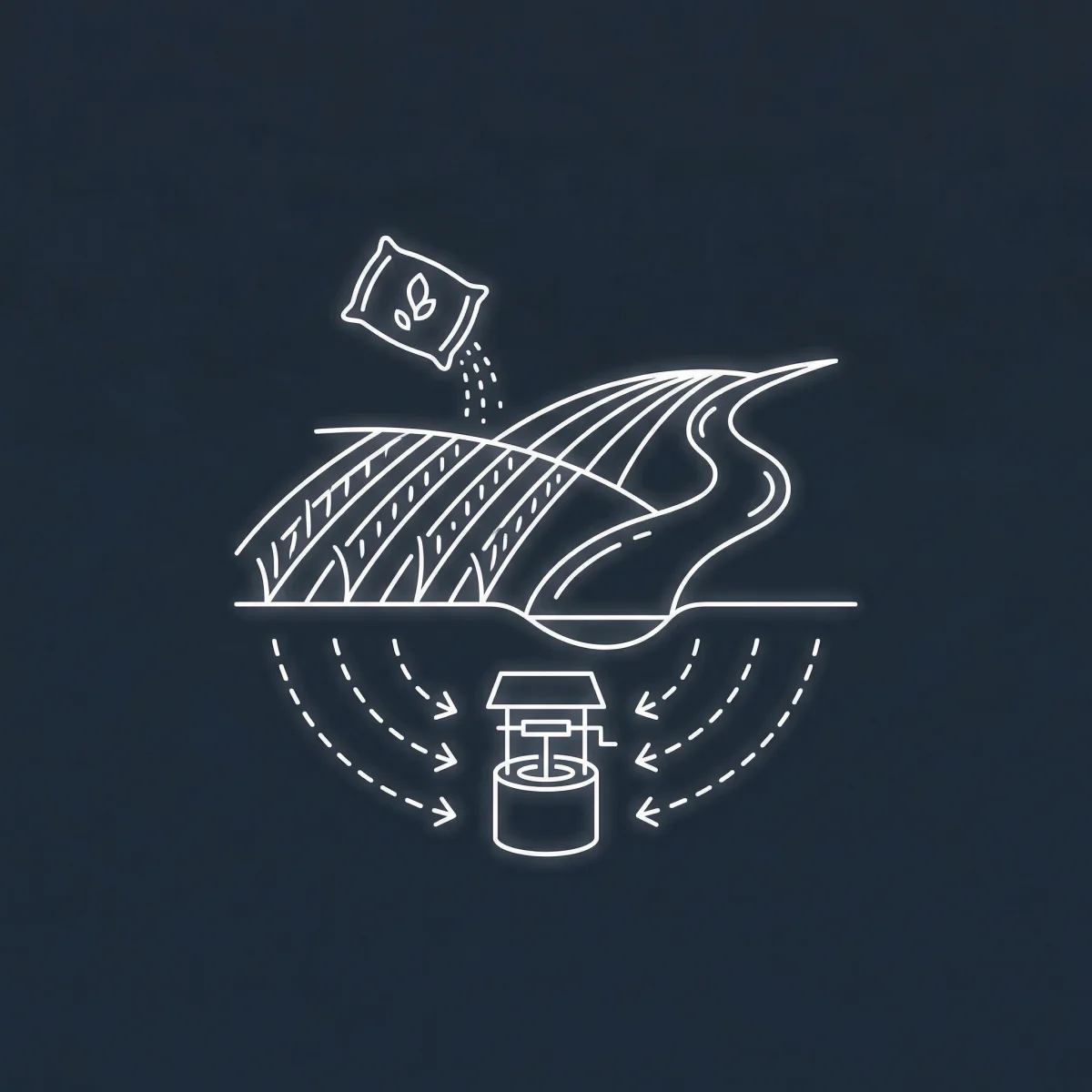
Drive north on Route 75 through Windsor Locks and into Suffield in early summer and you'll see shade cloth stretched over the tobacco fields, those long white canopies that have marked this landscape since the 1800s. Connecticut shade-grown tobacco, used for cigar wrappers, was once among the most valuable crops per acre in the United States. The fields are smaller now. They're still there, and so is what the farming left behind in the soil.
Part of that legacy is decades of nitrogen fertilizer. Nitrogen makes tobacco grow fast and produce large, pliable leaves. It also leaches straight through sandy river-valley soil into the groundwater underneath.
The Connecticut River Valley towns (Windsor, Windsor Locks, Suffield, Enfield, East Windsor, South Windsor) sit on some of the most permeable soils in the state. The glacial outwash deposits that make this land good for farming also make it easy for anything on the surface to reach the water table. What goes on the fields goes into the wells.
How Bad Are Nitrates in the Connecticut River Valley?
The federal maximum contaminant level for nitrates in drinking water is 10 milligrams per liter. That limit exists to protect infants. Above 10 mg/L, nitrates interfere with the blood's ability to carry oxygen, causing methemoglobinemia, a condition that turns a baby's skin blue and can be fatal. The limit has stood since 1991.
For adults, the picture gets complicated, because that 10 mg/L number was never about them. Research published in the International Journal of Epidemiology found that long-term nitrate exposure well below the federal limit, as low as 3.87 mg/L, was associated with increased colorectal cancer risk in postmenopausal women. A 2021 study in Environmental Health Perspectives found similar associations with thyroid cancer.
The federal limit, in other words, is not a "safe" threshold for adults. It's a threshold set to prevent the most acute effect in the most vulnerable population.
Why Did Nitrate Levels Spike After the Storms?
The Giroux family in East Windsor, whose story Inside Investigator reported in 2025, tested clean in 2016. By 2021, after the remnants of Hurricane Ida dumped heavy rain across the Connecticut River Valley, their nitrates had gone from 5.6 mg/L to 20 mg/L. Twice the federal limit.
Theirs is not an isolated story. Hydrologists have documented the pattern for years: extreme rainfall flushes surface nitrates into groundwater faster than the soil can process them. The valley's permeable soils make the effect sharper here than almost anywhere else in the state.
Connecticut has experienced more extreme precipitation events in the past decade than in any comparable period in recorded history. The USGS has documented how these precipitation changes directly impact groundwater quality in agricultural regions. The state's well testing requirements have not changed since 1991.
The EDB Legacy That Complicates Everything
There is an additional layer to the Connecticut River Valley's water quality story that almost nobody outside of state environmental agencies knows about.
In the 1970s and 1980s, a pesticide used on tobacco crops, ethylene dibromide (EDB), turned up in groundwater across the valley. EDB is a probable human carcinogen. The contamination was serious enough that the state set up a monitoring program for affected wells, and it has been running for decades.
Here's the problem. That program tests for EDB. Only EDB. When the state mails a "safe" letter to a homeowner in the monitoring zone, it means EDB levels are acceptable. It says nothing about nitrates, PFAS, bacteria, radon, or anything else.
So the Giroux family got "safe" letters from a state agency that was actively monitoring their well, while their nitrates sat at twice the federal limit. That wasn't a bureaucratic error. It was the system working exactly as designed. The program was built to watch one contaminant from one historical event. Nobody built it to watch for anything else.
Who Needs to Pay Attention
Want ZIP-level context before deciding whether to test? Enter your ZIP code at CheckYourTap.com to see available public-system or regional monitoring records associated with the ZIP. This is not a test of a tap, well, or property. Free, in 30 seconds.
If you own a private well in Windsor, Windsor Locks, Suffield, Enfield, East Windsor, South Windsor, or any of the farming towns in the Connecticut River Valley, and your last comprehensive water test was more than two years ago, you don't know what's in your water.
That goes double if your well sits near active farmland, near a horse farm or livestock operation, or near land that was farmed hard in the past. It also goes double if your well is shallow, under 50 feet, because shallow wells connect more directly to surface water and take on runoff more easily.
The CT Department of Public Health recommends testing well water annually for bacteria and nitrates, plus a comprehensive panel every three to five years. A nitrate test alone costs under $50. Treating nitrate-contaminated water, usually with a reverse osmosis system, runs $300 to $800 installed. Nitrates also aren't the only worry for well owners around here. Arsenic is another common threat in Connecticut wells.
The cost of not knowing is harder to calculate.
Keep Reading
- The Water Test You Got When You Bought Your House Is Worthless Now
- Your Well Water Arsenic Test Came Back 'Safe.' Here's Why That Might Not Mean What You Think.
- The Water Test Your Bank Required Doesn't Test for What's Actually Dangerous
Sources: Inside Investigator / Marc E. Fitch, "Passing the Buck," July 27, 2025; International Journal of Epidemiology, nitrate and colorectal cancer study; Environmental Health Perspectives, 2021; CT DPH Private Well Water Program; CT DEEP EDB Monitoring Program.
